
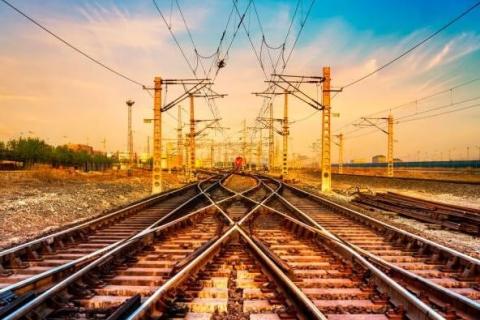
Modern heavy rail networks, municipal light rail corridors, and diesel-electric transit lines rely entirely on microprocessors and solid-state electronics to maintain scheduled freight routes and commuter passenger traffic safely. From vital trackside signaling relays to digital communication networks and traction power distribution systems, even a microsecond electrical spike disrupts service instantly. Installing an industrial-grade surge protection device is no longer a secondary design consideration; it forms the core defense line keeping essential rail infrastructure online across American transit networks.
Key Takeaways
- Divert dangerous transient voltage spikes safely straight to ground terminals before sensitive trackside electronics fry.
- Safeguard remote signaling hubs, PTC units, and high-voltage substations exposed to severe outdoor field hazards.
- Cut recurring maintenance costs by shielding digital relays and solid-state infrastructure from persistent micro-surges.
- Secure uninterrupted train dispatching while extending operational longevity across long-distance transit corridors.
- Work alongside Swartz Engineering to deploy custom, industrial-grade electrical protection engineered specifically for heavy rail environments.
What Is a Surge Protection Device and How Does It Safeguard Trackside Electronics?
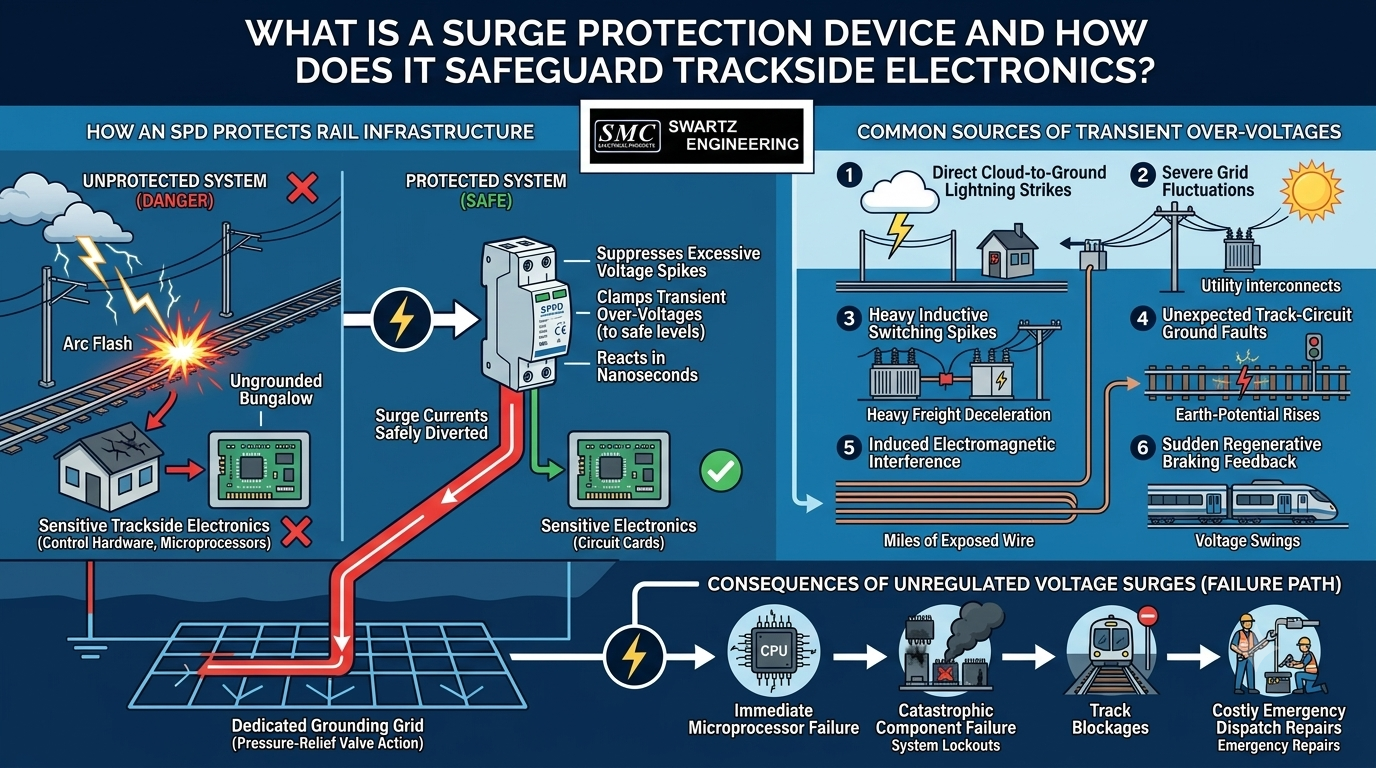
A surge protection device protects high-voltage rail infrastructure by suppressing excessive voltage spikes and clamping transient over-voltages down to safe operating levels. The system reacts in nanoseconds, acting like a pressure-relief valve by safely channeling destructive surge currents away from sensitive trackside control hardware and directly into dedicated grounding grids before high-energy arc flashes damage connected circuit cards.
The reality on the ground is that transient over-voltages routinely hammer rail lines through multiple environmental and operational pathways:
- Direct cloud-to-ground lightning strikes hitting overhead catenary lines, running rails, or nearby wayside signal bungalows.
- Severe grid fluctuations spilling over from primary utility interconnects during peak summer loading events.
- Heavy inductive switching spikes caused by high-voltage circuit breakers opening across traction substations.
- Unexpected track-circuit ground faults triggering massive earth-potential rises across local signaling zones.
- Electromagnetic interference induced across thousands of feet of exposed, parallel copper cabling.
- Sudden voltage swings generated by regenerative braking feedback loops during heavy freight deceleration.
When thousands of unregulated volts surge through sensitive signal racks, sensitive microprocessors fail immediately. Components fail catastrophically, forcing localized system lockouts, severe track blockages, and costly emergency dispatch repairs.
GET IN TOUCH
The ultimate solution for reliable power control! call us at 276-285-3841
Why Are Modern Railway Systems So Vulnerable to Electrical Surges?
Railways face severe surge vulnerabilities because their interconnected steel rails, long cable runs, and high-voltage catenary lines act as giant antennas for lightning strikes and utility disturbances. Spanning hundreds of miles of open terrain, these vast metal networks collect stray currents and transient spikes, sending high-energy surges deep into unshielded wayside signal control boxes and remote switching stations.
Here is the part most technicians spot in the field: modern rail corridors run on complex, interconnected electrical webs that operate under harsh physical conditions:
- Extensive high-voltage traction power networks running parallel to low-voltage control circuits.
- Unshielded wayside bungalows, trackside transponders, and junction boxes exposed to severe weather elements.
- Sensitive low-voltage microprocessors operating right alongside high-energy 750V DC or 25kV AC propulsion systems.
- Thousands of feet of exposed signaling line wire linking isolated track blocks across rural regions.
- Interdependent digital control networks where an electrical fault in one sector halts operations across the whole line.
Unlike isolated manufacturing facilities operating behind controlled building envelopes, open transit corridors cannot isolate their equipment from raw outdoor electrical environments. An unchecked voltage surge hitting an isolated track block ripples down the line, disabling multiple interlocking systems at once. Protecting these interconnected networks requires robust, system-wide suppression strategies.
How Does Surge Protection Improve Overall Railway Operational Safety?
Properly engineered surge protection improves railway safety by preventing transient voltage spikes from causing fail-safe signaling errors, digital lockouts, and critical communication blackouts. When protective clamping devices absorb high-energy electrical transients, vital interlocking systems stay fully functional, preventing false-clear signal indications and ensuring emergency braking systems respond instantly when needed.
System engineers rely on heavy-duty surge suppressors to insulate high-risk operational assets:
- Vital wayside signaling relays, switch machines, and Positive Train Control (PTC) trackside units.
- Fiber-optic transceivers, trackside radio bases, and centralized dispatcher communications links.
- Main traction substations, step-down transformers, and high-voltage DC distribution panels.
- Environmental sensors, hot journal axle detectors, and automated wheel impact load monitors.
- SCADA control networks, remote terminal units (RTUs), and automated crossing gate controllers.
Integrating dedicated transient suppression throughout trackside enclosures significantly lowers the chance of sudden component failure during heavy lightning storms. Protecting these core control systems keeps trains running on schedule and ensures field crews work around reliable, fully functional equipment.
Comparing Protection Strategies: Basic vs. Industrial Railway Suppression
|
|
|
|
|
|
|
|
|
|
|
|
|
|
|
|
|
|
|
|
|
|
|
|
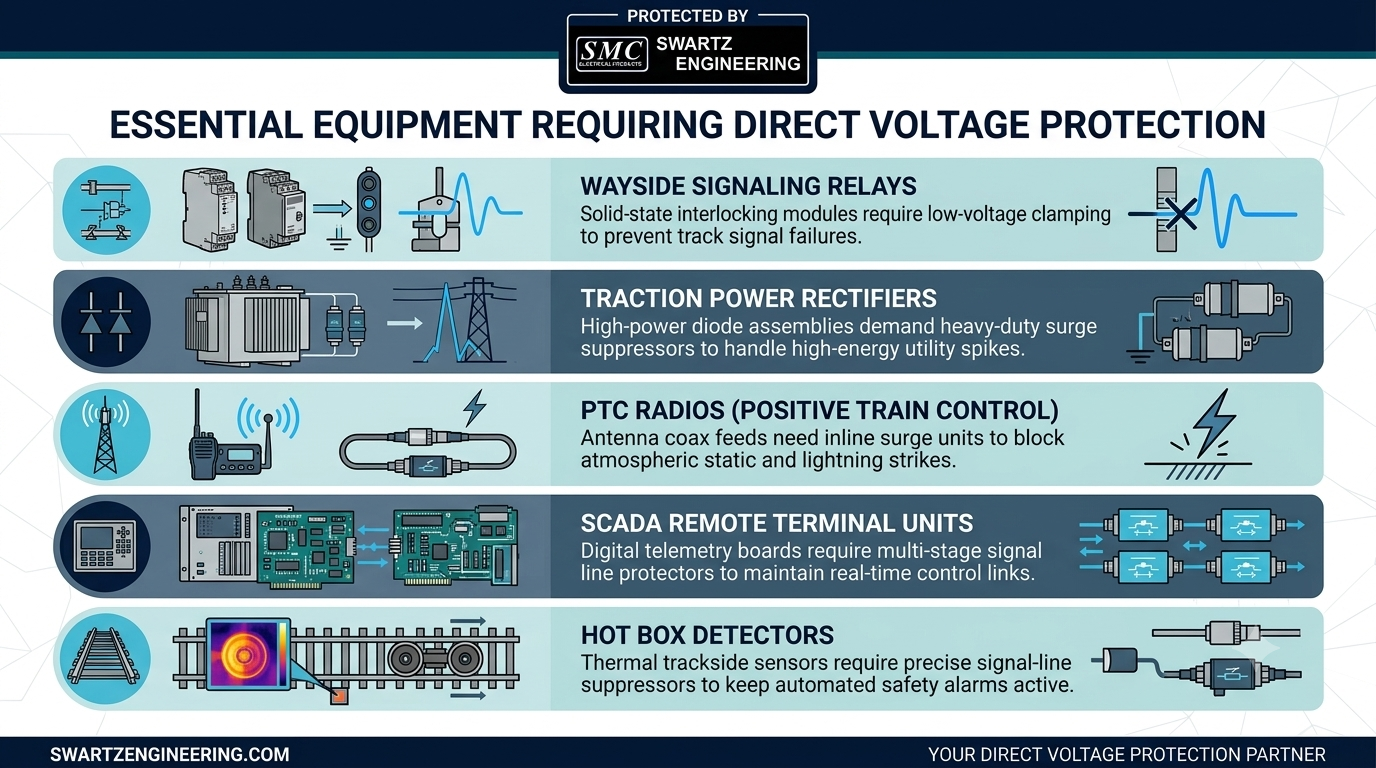
Essential Equipment Requiring Direct Voltage Protection
- Wayside Signaling Relays: Solid-state interlocking modules require low-voltage clamping to prevent track signal failures.
- Traction Power Rectifiers: High-power diode assemblies demand heavy-duty surge suppressors to handle high-energy utility spikes.
- Positive Train Control (PTC) Radios: Antenna coax feeds need inline surge units to block atmospheric static and lightning strikes.
- SCADA Remote Terminal Units: Digital telemetry boards require multi-stage signal line protectors to maintain real-time control links.
- Hot Box Detectors: Thermal trackside sensors require precise signal-line suppressors to keep automated safety alarms active.
Field Insights for Rail Maintenance Crews
Pro Tip: Never route surge protector grounding wires in tight loops or parallel to protected output cables. High-energy lightning transients carry extremely high frequency components; sharp 90-degree bends in ground wires create high inductive reactance, causing high-voltage flashovers right across your control boards before the suppressor can direct energy to earth. Keep ground leads as straight, short, and heavy-gauge as possible.
GET IN TOUCH
The ultimate solution for reliable power control! call us at 276-285-3841
Taking the Next Step Toward Complete Infrastructure Protection
Unprotected electrical transients threaten your operational continuity, leading to unexpected signal outages, costly equipment repairs, and major service delays across your line. Protecting complex rail networks requires specialized electrical engineering designed specifically for tough transit environments.
Swartz Engineering manufactures field-tested electrical protection systems designed to withstand heavy traction currents, severe weather hazards, and intense vibration levels. Our team analyzes your trackside power distribution networks, pinpointing vulnerabilities and delivering custom suppression systems built to keep your transit operations running safely.
Call Swartz Engineering today to speak with an experienced rail engineer, review your system specifications, and secure your trackside equipment with an industrial surge protection device solution built for long-term reliability.
Frequently Asked Questions
Q: What does a surge protection device do in railway systems?
A: A surge protection device diverts excess electrical voltage away from sensitive railway equipment during transient spikes. It redirects high-energy surges straight into a grounding electrode, protecting signaling relays, communication gear, and substation controls from permanent damage.
Q: What causes electrical surges in railway infrastructure?
A: Surges stem from direct or indirect lightning strikes, main utility power grid fluctuations, high-voltage breaker switching in substations, and sudden line-to-ground faults. Electromagnetic interference generated along long parallel cable runs also induces damaging voltage spikes into low-voltage signal lines.
Q: Which railway equipment needs protection from transient over-voltages?
A: Essential equipment requiring protection includes solid-state signaling interlockings, track circuits, Positive Train Control (PTC) radio systems, traction substations, SCADA remote terminal units, and trackside safety sensors like hot box detectors.
Q: Can installing surge protection reduce ongoing railway maintenance costs?
A: Yes. Suppressing transient over-voltages prevents premature component wear and eliminates sudden circuit card burnouts, saving rail operators thousands of dollars in emergency trackside repairs, replacement parts, and line disruption costs.
Q: Why is surge protection critical for modern digital railway technology?
A: Modern digital rail infrastructure uses low-voltage microprocessors that are far more sensitive to voltage swings than legacy mechanical relays. Proper surge suppression blocks voltage spikes before they corrupt digital memory cards, freeze automated controls, or burn out micro-components.
Products We Offer
Swartz Engineering strives to provide top-quality products to achieve our customer's needs. Our products include:
- Type 76 DC Relay
- Type 82 DC Relay
- Swartz Engineering’s Type 64 Ground Relay
- Type 32 Reverse Current Relay
- Type 150 DC
- CSM Shield Monitor
- Metal Oxide Surge Arrestors
- Transducers
- MVIS SL Slim-line Contactor
- Fully-tested Power Control Rooms
- Swartz Engineering’s Portable Substations
For nearly half a century, we have proudly led the industry in ensuring safety and efficiency. Swartz Engineering is a trusted family-owned company dedicated to providing top-notch power distribution solutions for the electrical industry. Contact us today.