
Some of the scariest faults we think about at Swartz Engineering start really small. Picture a cable lug inside a DC breaker cubicle, rubbing against the steel frame for months as every passing train sends a little vibration through the floor. One humid morning, the last of the insulation wears through.
Nothing trips. Nobody notices.
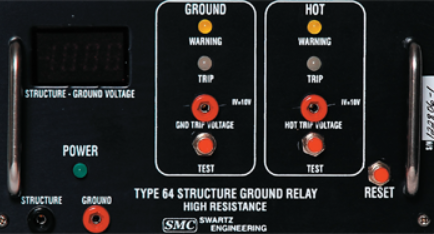
But the cabinet a technician leans on every week is now sitting at a voltage above ground. That's the kind of failure a type 64 ground relay is built to catch, and it's why we build the SWARTZ Type 64 Ground Relay, which provides two functions in one unit for high-resistance-grounded DC switchgear and rectifiers.
Key Takeaways
- DC switchgear is usually built with the enclosure insulated from ground through a high resistance.
- Touch voltage is what a person could feel by touching a structure while standing on the ground.
- Front panel test buttons let crews check the grounded structure alarm and the hot structure trip without special tools.
- Many stations pair the type 64 ground relay with a CSM Shield Monitor to watch feeder cable insulation, plus metal oxide surge arrestors for transient protection.
Start with how the station is grounded
DC switchgear is usually built with the enclosure insulated from ground through a high resistance. In that kind of design, the switchgear frame connects to the station ground through a resistor, and the frame normally sits close to ground.
That resistor is the path the relay watches.
Because of that high resistance, a single failure like our worn lug doesn't announce itself. You need something actively looking.
Two failures, two responses
The Type 64 watches for two different problems, and it treats them differently on purpose.
A grounded structure means the frame has found a direct path to ground somewhere, maybe a bolt through failed insulation on a mounting rail. The station can usually keep running. Still, one layer of protection is gone, and the next failure could be worse. So the relay raises an alarm through front panel lights and output contacts, and your staff can track down the cause.
A hot structure is the dangerous one, and it's what the worn lug creates. Current leaks from the energized bus to the frame, and the frame voltage climbs. Anyone who touches the cabinet could be exposed.
The hot structure function detects both AC and DC leakage and faults. When it sees one, the relay trips. Its trip output is normally wired to a lockout relay, which de-energizes the station.
Why there's a time delay
When frame voltage climbs past the setpoint, the relay waits out a short internal time delay before tripping.
That delay is there to ride through brief transients, so a momentary spike doesn't take a whole station down. If the voltage holds, the relay trips, the lockout opens the breakers, and the station goes dark before anyone walks in.

GET IN TOUCH
The ultimate solution for reliable power control! call us at 276-285-3841
Touch voltage is the reason this matters
Touch voltage is what a person could feel by touching a structure while standing on the ground.
In a traction system, rail and structure voltages can rise during heavy load or a fault. If someone touches an energized frame, current can pass through their body. Standards set limits on how high those voltages can go and for how long.
A ground relay with the right pickup and time delay trips fast enough to keep that exposure short. Some systems also add voltage-limiting devices that briefly tie the rail to ground when its voltage climbs too high.
The slower problem: stray current
There's a quieter risk in the background, too.
Current in a DC traction system flows from the substation out through the overhead wire or third rail, into the train and back through the running rails. Those rails aren't perfectly insulated from the earth, so some current leaks into the soil, travels through nearby pipes and structures and finds another way home.
Where it leaves a metal structure and enters the soil, it causes corrosion. Over years, that can weaken buried pipe, rebar and structural supports.
It also means frames and enclosures in a substation may sit at a voltage that isn't true ground. The Type 64 watches for those voltages so problems get found fast.
After a trip
When technicians show up to a locked-out station, the relay's front panel tells them it was a hot structure trip. Then it's old-fashioned detective work, cubicle by cubicle, looking for something like a shiny spot on a lug where it touched the frame.
Fix the cause properly. Replace the damaged part, add a protective boot and re-dress the cable away from the steel.

Test before you reset
Front panel test buttons let crews check the grounded structure alarm and the hot structure trip without special tools.
Also check the insulation between the structure and ground. A degraded insulator can create a path that bypasses the sensing element and hides future faults. We'd never skip that step.
Write the readings down. Over time, those records show whether insulation is wearing and whether settings need to change.
The relay watches itself, too
Self-diagnostics alert your staff if the relay fails or gets bypassed.
That matters more than people think. A protection device that quietly stops working is worse than none at all, because everyone assumes it's still on duty.
When should you specify one?
Any DC traction or industrial station that uses high resistance grounding for its switchgear or rectifier enclosures is a good candidate.
Retrofits come up a lot as well. Older electromechanical structure relays are hard to test, and spare parts are getting scarce. Setpoints for both functions on the Type 64 are adjustable, so we can tune it to your station.
Hot structure or grounded structure scheme?
You'll also need to decide how your station's frames are arranged.
In a hot structure scheme, equipment frames are insulated from ground and tied to it only through a sensing element. A fault from the positive conductor to the frame sends current through that element, and the relay trips the feeders.
In a grounded structure scheme, frames bond straight to station ground. A fault becomes a direct short, and the relay senses it through the ground connection.
The right choice depends on how the system was designed, the soil and your agency's approach to stray current. We're happy to talk it through.
Many stations pair the type 64 ground relay with a CSM Shield Monitor to watch feeder cable insulation, plus metal oxide surge arrestors for transient protection. Our article on why high voltage grounding matters in railway systems explains the grounding side in more depth.
Get Help With Your Ground Protection Scheme
Call Swartz Engineering at 276-285-3841 or contact us. Share your station voltage and grounding method, and we will help you set up the type 64 ground relay. Full specs are on the Type 64 product page.
Frequently Asked Questions
Q: Will it detect AC leakage?
A: Yes. The hot structure function detects both AC and DC leakages and faults.
Q: Can I test it in place?
A: Yes. Front panel test buttons cover both the ground structure alarm and the hot structure trip.
Products We Offer
Swartz Engineering strives to provide top-quality products to achieve our customer's needs. Our products include:
- Type 76 DC Relay
- Type 82 DC Relay
- Swartz Engineering’s Type 64 Ground Relay
- Type 32 Reverse Current Relay
- Type 150 DC
- CSM Shield Monitor
- Metal Oxide Surge Arrestors
- Transducers
- MVIS SL Slim-line Contactor
- Fully-tested Power Control Rooms
- Swartz Engineering’s Portable Substations
For nearly half a century, we have proudly led the industry in ensuring safety and efficiency. Swartz Engineering is a trusted family-owned company dedicated to providing top-notch power distribution solutions for the electrical industry. Contact us today.