
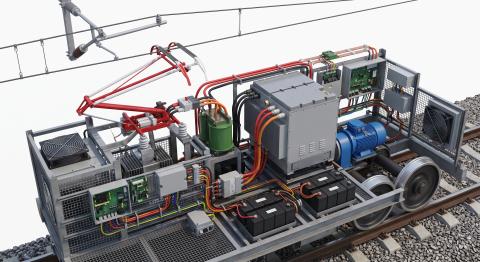
It requires a huge amount of power to move a fully laden train. No matter how much a railway carries, whether it be people (passenger), dry bulk commodities, or heavy freight, the electrical infrastructure must react to changing demand without voltage problems, equipment fault events, and, naturally, overloads causing operational delays.
The train power system manages these tasks through an interconnected network of substations, transformers, feeders, switchgear, protection equipment & controls, and the on-board electrical equipment of the train. Every component has its designated role, yet they must collaborate whenever a train begins to move, speeds up, goes uphill, or operates in any other low-power operating scenario.
At Swartz Engineering, we design and manufacture electrical power-distribution equipment that forms the backbone of demanding industrial and transportation applications. Knowing how traction loads move through the system is key to understanding why dependable rail power is so much more than just running electricity on the rails.
Key Takeaways
- The train power system must manage large and fast-changing electrical loads in specific operating conditions.
- Before reaching a train, traction power substations change it, and control and distribute electricity.
- Some railway electrification systems accomplish delivery of substantial power using higher-voltage AC systems, such as 25 kV AC.
- Transformers, switchgear, breakers, relays, and monitoring equipment protect the network but facilitate normal high traction demand.
- Distributed locomotive power may be used to distribute tractive effort in the context of a very long train and inter-car forces for heavy freight applications.
- Consistent with designing the network of power and protection networks to be operated as a single unified system.
How Does a Train Power System Handle Heavy Loads?
The train power system provides sufficient electrical energy to drive the traction motor and manages voltage, current, equipment temperature, and fault conditions within its parts of the network where it operates.
In the case of an externally powered railway, electricity is generally from the utility supply. Between the high-voltage national grid and railways are traction substations that condition electricity for railway use before feeders transport it along an overhead contact system or a third rail. That energy is then collected by the train and used as mechanical drive force at the wheels.
A simplified electrical path looks like this:
Utility power → traction power substation → feeders → overhead line or third rail → train → traction motors
Modern electrification on railroads, according to the Federal Railroad Administration, can involve overhead catenary systems as well as high-voltage AC (alternating current), including 25 kV configurations. The specific layout will vary according to the route, rolling stock, electrical network, operating requirements, and already existing infrastructure.
Every link in this chain is under more stress with heavy loads.
Traction Power Substations Supply the Energy Trains Need
A traction power substation is one of the most important parts of an electric railway.
Utility electricity normally cannot simply be connected directly to a train. The incoming electrical supply needs to be transformed, and in some systems converted, before it can be distributed to the railway.
Depending on the system, traction substations can perform several functions:
- Transform incoming voltage to the railway's required level
- Convert AC power to DC when necessary
- Feed electrical power into the railway distribution network
- Control and isolate different electrical sections
- Detect abnormal current or fault conditions
- Support monitoring and remote system control
Swartz Engineering's rail guidance describes traction substations as the connection between utility power and the railway electrification network. AC and DC rail systems require different arrangements of transformers, rectifiers, switchgear, and protection equipment.
That becomes particularly important when several trains are drawing significant power from the same network.
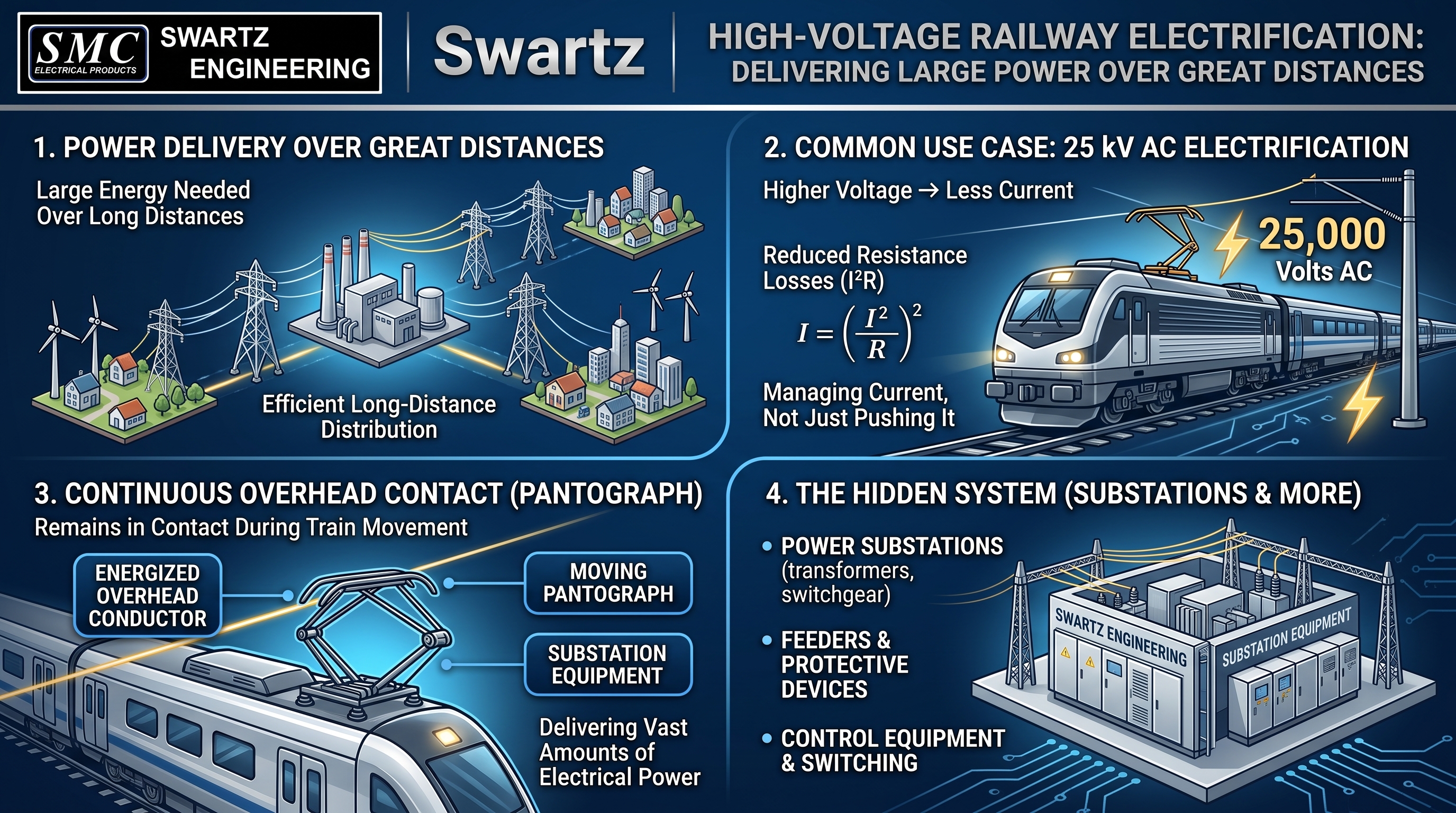
High-Voltage Distribution Helps Move Large Amounts of Power
Some railways use high-voltage AC overhead electrification where large amounts of energy need to be delivered over greater distances.
For example, 25 kV AC electrification is a frequently used case.
Rather than pushing very high current through the distribution network, a higher voltage will deliver vast amounts of electrical power while managing current (and these losses). That power is managed by the railway infrastructure before it gets wasted by the train.
Pantographs are mounted to the roof of the train on overhead systems. During the movement of the train, the pantograph remains in contact with the energized overhead conductor.
But the critical point is that the wire above the train isn't just the visible tip of a much larger system. Substations, transformers, feeders, protective devices, and control equipment; switching underlies
GET IN TOUCH
The ultimate solution for reliable power control! call us at 276-285-3841
Transformers Manage Voltage for Heavy Traction Demand
Transformers allow a train power system to move electricity between voltage levels appropriate for utility supply, distribution, and railway operation.
During periods of heavy acceleration or sustained traction demand, transformers may be exposed to substantial electrical and thermal loading.
They must therefore be selected around more than nominal voltage alone. Engineers also have to consider factors such as:
- Maximum expected traction demand
- Repeated acceleration cycles
- Thermal loading
- System fault levels
- Voltage fluctuations
- Peak operating conditions
- Future increases in service or train frequency
The right transformer configuration depends on the railway itself. A metro system running frequent trains has different load patterns from a mainline railway handling longer trains across greater distances.
Starting and Acceleration Create Major Power Demands
A train does not draw exactly the same amount of power throughout a trip.
Starting and accelerating can create especially demanding electrical conditions. The system has to provide high traction power while still maintaining acceptable electrical performance.
This creates an important challenge for protection design.
High current does not automatically mean something is wrong.
A genuine electrical fault and normal heavy train acceleration can both involve substantial current, but the system must respond differently to each event. Protection equipment therefore needs to distinguish between expected operating conditions and currents that indicate an overload, short circuit, ground fault, or other problem.
Swartz Engineering's railway protection guidance specifically addresses this challenge, including protection that accounts for heavy current associated with normal train starting.
Switchgear Controls and Protects Heavy Electrical Loads
Switchgear gives railway operators the ability to control, disconnect, and protect different portions of the traction power network.
Circuit breakers, disconnect switches, relays, and related equipment can isolate a fault before it affects a larger section of the railway.
For example, if an abnormal electrical condition develops on one feeder, properly coordinated protection may allow the affected section to be disconnected while limiting damage to transformers, cables, contact systems, or other expensive equipment.
Railway switchgear may be required to handle:
- Normal high-current traction demand
- Overloads
- Short circuits
- Ground faults
- Switching events
- Voltage transients
- Equipment isolation for maintenance
Swartz Engineering identifies circuit breakers, disconnect switches, and protective relays as important elements in railway power applications.
The goal is not simply to shut the power off quickly. The system must shut it off when necessary without interrupting service every time a train creates a normal surge in demand.
Protection Relays Help Separate Normal Loads From Faults
Protection relays continually monitor electrical conditions and determine when breakers need to operate.
That distinction matters in heavy rail applications because a system designed too sensitively may trip during normal train operation. A system that responds too slowly to a real fault can expose equipment to additional damage.
Depending on the application, protection can monitor conditions such as:
- Current magnitude
- Rapid current changes
- Voltage
- Ground faults
- Reverse current
- Short circuits
- Other abnormal electrical behavior
When a dangerous condition is detected, the relay sends a command to the appropriate circuit breaker so the faulted portion of the system can be isolated.
This coordination between sensing, decision-making, and interruption is one of the reasons modern train power systems can support large electrical loads while maintaining dependable protection.
Traction Motors Turn Electrical Power Into Pulling Force
Supplying electricity is only part of the process. The locomotive or powered railcar must convert that electrical energy into usable tractive effort.
Traction motors provide torque at the driven axles. Modern traction control systems regulate that torque so the wheels can apply as much useful force as practical without excessive wheel slip.
Wheel-to-rail adhesion becomes especially important when:
- Starting a heavy train
- Climbing a grade
- Operating on wet or contaminated rail
- Pulling long freight consists
- Accelerating under high load
Modern locomotives can regulate individual axle or motor behavior to improve available adhesion. Sanding systems may also be used to increase wheel-to-rail friction when conditions require it.
The result is controlled application of torque rather than simply sending maximum power to the wheels.
Distributed Power Helps Long Freight Trains Manage Forces
Heavy freight introduces another challenge: supplying traction is not enough. The train must also manage the mechanical forces traveling through hundreds of railcars and couplers.
One solution is distributed power.
Instead of placing every locomotive at the front, locomotives can be positioned at different points within or at the rear of the train. The additional locomotive units can then be controlled remotely in coordination with the lead locomotive.
The Federal Railroad Administration describes distributed power configurations in which locomotives are positioned along long freight trains and remotely controlled from the lead units. FRA research also shows that train dynamics involve substantial coupler forces, making the management of tractive and braking forces important for safe heavy-train operation.
Spreading locomotive effort throughout the consist can help:
- Reduce extreme forces between railcars
- Improve management of train slack
- Distribute tractive effort
- Improve braking behavior
- Support operation of longer and heavier consists
Distributed power should therefore be viewed as part of overall train dynamics rather than simply as a way to add more horsepower.
What Happens When Several Trains Demand Power at Once?
One of the harder problems in railway electrification happens when multiple trains accelerate within the same electrical area.
The issue is no longer the load of a single train. Engineers have to consider the combined demand placed on the traction network.
For example, one train may be leaving a station while another is climbing a grade and another is operating elsewhere on the same supply section.
The power system must be designed around realistic operating scenarios, including:
- Train frequency
- Simultaneous acceleration
- Route gradients
- Train weight
- Substation spacing
- Feeder capacity
- Voltage limits
- Available utility supply
- Failure or maintenance conditions
This is why simply installing a larger transformer does not automatically solve every heavy-load problem. The entire electrical network has to be evaluated together.
Why Substation Spacing Matters
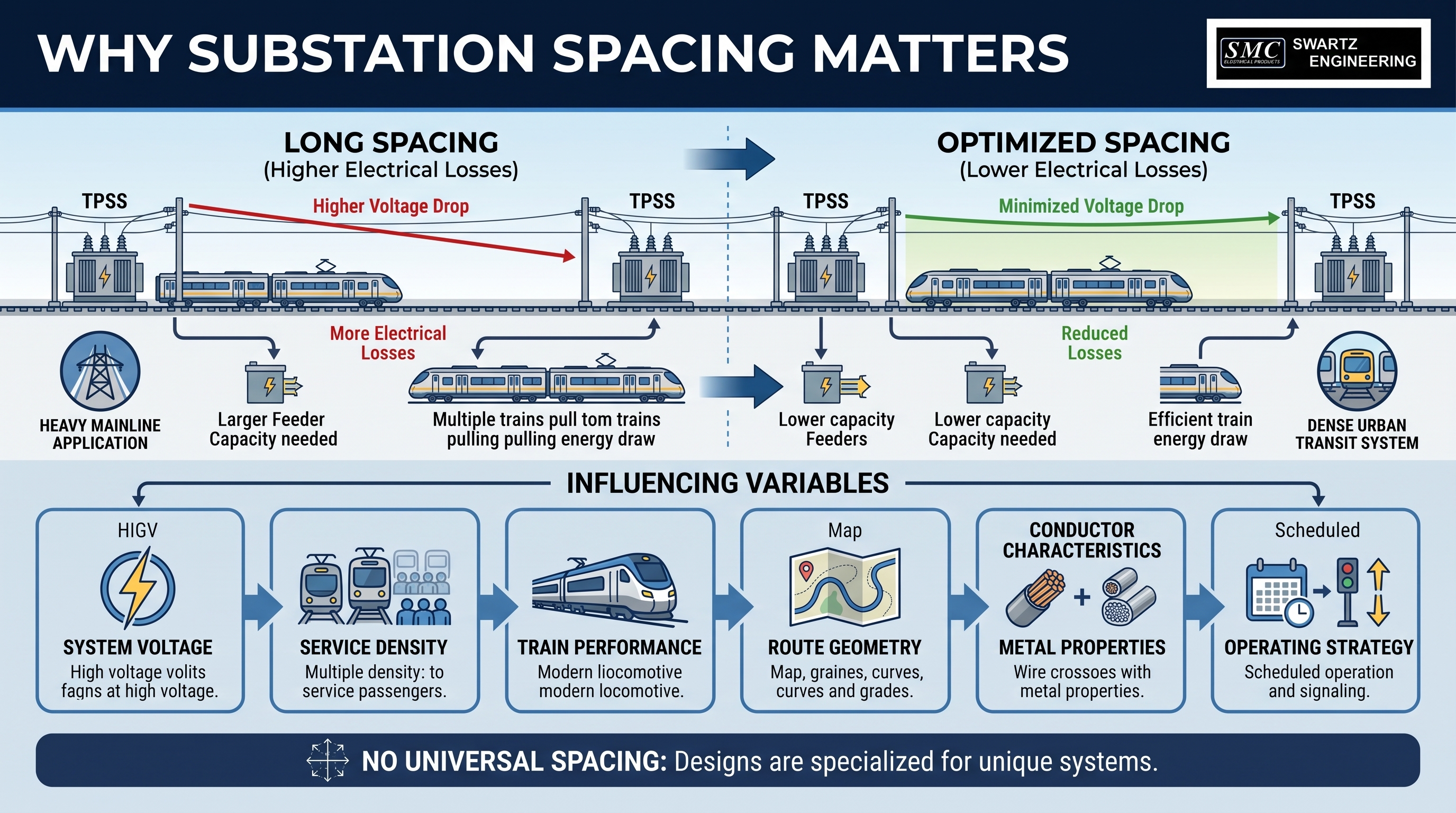
Traction power substations are placed along an electrified railway according to the electrical requirements of the system.
Spacing affects how far electricity must travel before reaching the train. The farther power travels through a conductor, the more designers must account for voltage drop, electrical losses, feeder capacity, and the number of trains drawing energy from the section.
Substation requirements therefore depend on variables such as system voltage, service density, train performance, route geometry, conductor characteristics, and operating strategy.
There is no universal spacing that works for every railway.
A heavy mainline application and a dense urban transit system can require very different electrical designs.
GET IN TOUCH
The ultimate solution for reliable power control! call us at 276-285-3841
Heavy Loads Also Create Heat
High electrical demand produces heat in transformers, cables, conductors, switchgear, motors, and other system components.
Repeated heavy loading without adequate thermal design can shorten equipment life or create reliability problems.
Engineers therefore consider:
- Continuous current ratings
- Short-duration overload capability
- Cooling requirements
- Enclosure ventilation
- Ambient temperature
- Duty cycles
- Equipment location
Rail electrical equipment may also be installed in difficult environments exposed to moisture, dust, vibration, temperature changes, and corrosion.
Swartz Engineering designs and builds electrical power-distribution equipment for challenging environments, using construction intended to provide environmental protection and structural strength. The company's published quality procedures also describe factory testing to applicable IEEE and NEMA standards.
Monitoring Helps Operators Understand Changing Loads
Modern railway power systems also depend on measurement and control.
Current and voltage transducers, protection equipment, communications, and supervisory controls can provide operators with information about what is happening throughout the network.
Monitoring can help teams identify:
- Abnormal current
- Voltage changes
- Equipment loading
- Breaker status
- Fault locations
- Transformer conditions
- Feeder performance
Instead of treating electrical equipment as isolated components, operators gain a broader view of how the traction network is behaving.
That visibility becomes increasingly important as train frequency and electrical demand increase.
Building a Reliable Train Power System for Heavy Loads
System-level engineering is our most powerful lever for heavy railway loads.
The Transformers must follow actual load. Switchgear is expected to accommodate the operating and fault current. Protection relays must detect true faults without mistaking normal traction loads as an abnormal condition. While providing power, the feeder must maintain acceptable voltage, and the monitoring equipment should provide useful information to the operators about the system conditions.
Everything helps one another, but better than everything is coordination.
Swartz Engineering specializes in electrical power distribution and high-demand equipment. We have capabilities for our rail-related traction power distribution equipment, switching, protection, measurement, and control. With nearly 50 years of expertise in the electrical power industry, Swartz Engineering designs products for demanding operating environments.
For dependable railway traction power distribution, protection, switching, monitoring #control equipment, contact Swartz Engineering for your railway electrical system needs
Frequently Asked Questions
Q: What is a train power system?
A: A train power system is the network that supplies, converts, distributes, controls, and protects the energy used to move a train. In an electrified railway, it can include utility connections, traction substations, transformers, rectifiers, feeders, overhead lines or third rails, switchgear, protection devices, and onboard traction equipment.
Q: How does a train power system handle a heavy train?
A: The system provides the high electrical power required for traction while managing voltage, current, protection, and thermal conditions. Traction motors then convert electrical energy into torque at the train's driven axles.
Q: Why do electric railways need traction power substations?
A: Traction substations adapt utility electricity for railway use. Depending on the system, they can transform voltage, convert AC electricity to DC, distribute power to feeders, provide switching, and support electrical protection.
Q: Do all electric trains use 25 kV AC?
A: No. Railway electrification can use several AC and DC voltage arrangements. 25 kV AC is one important mainline electrification configuration, while many transit systems use lower-voltage DC supplies delivered through overhead contact systems or third rails.
Q: Why does a train draw more power when accelerating?
A: Acceleration requires the traction motors to produce substantial torque to increase the train's speed. A heavy train therefore creates much greater traction demand during certain operating conditions than when it is maintaining a steady speed.
Q: What is distributed power on a freight train?
A: Distributed power places locomotives at multiple positions within a freight train rather than concentrating all locomotive power at the front. The units can be remotely coordinated with the lead locomotive, helping distribute tractive and braking forces through long, heavy consists.
Products We Offer
Swartz Engineering strives to provide top-quality products to achieve our customer's needs. Our products include:
- Type 76 DC Relay
- Type 82 DC Relay
- Swartz Engineering’s Type 64 Ground Relay
- Type 32 Reverse Current Relay
- Type 150 DC
- CSM Shield Monitor
- Metal Oxide Surge Arrestors
- Transducers
- MVIS SL Slim-line Contactor
- Fully-tested Power Control Rooms
- Swartz Engineering’s Portable Substations
For nearly half a century, we have proudly led the industry in ensuring safety and efficiency. Swartz Engineering is a trusted family-owned company dedicated to providing top-notch power distribution solutions for the electrical industry. Contact us today.