
We build the SWARTZ Type 76 DC Overcurrent Relay here at Swartz Engineering in Bristol, Virginia, and most of the protection engineers who call us have the same headache. It usually sounds something like this: "Two trains leave the platform together at rush hour and climb a grade, and my old relays can't tell that from a fault two miles out."
That's a fair complaint, and it's exactly the problem this relay was built to solve.
So here's how we walk customers through writing a spec for a type 76 DC relay, roughly in the order the questions come up.
Key Takeaways
- Direct current never crosses zero, so once a DC fault starts, current keeps flowing until something forces it to stop.
- When a train accelerates, its propulsion controls ramp current up over a fraction of a second or longer.
- Front panel calibration controls let crews set thresholds and time delays on site during commissioning.
- A section insulator flashes over during a storm, and the rate of rise channel trips the feeder in a fraction of a second.
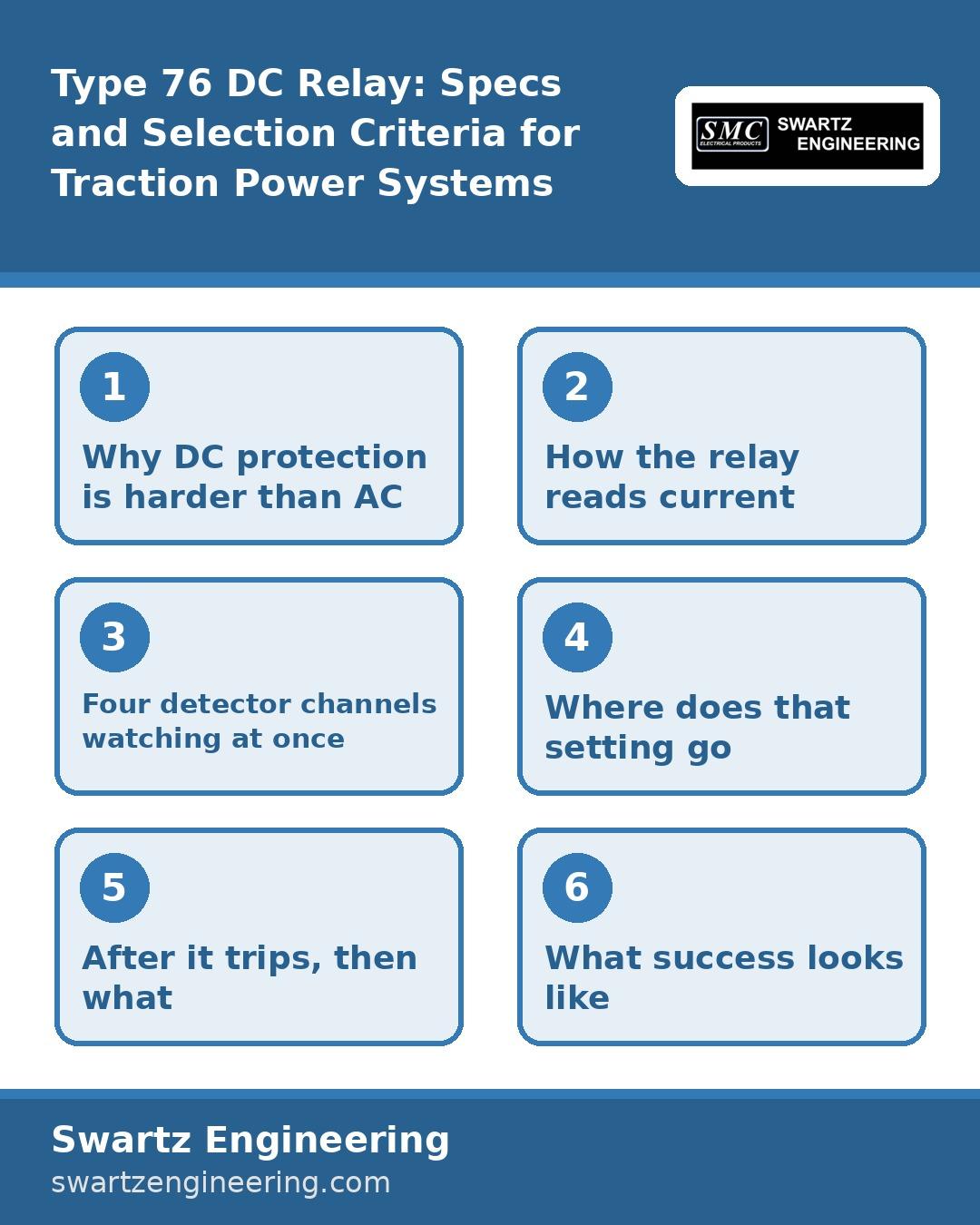
Why DC protection is harder than AC
Alternating current crosses zero twice every cycle. That helps breakers interrupt it, and it gives relays a tidy waveform to read.
Direct current never crosses zero, so once a DC fault starts, current keeps flowing until something forces it to stop.
On top of that, transit loads swing hugely during the day. A fault far down the line may draw about as much current as two trains starting at once. Looking at the size of the current alone can't sort the two apart, and that's the whole challenge.
How the relay reads current
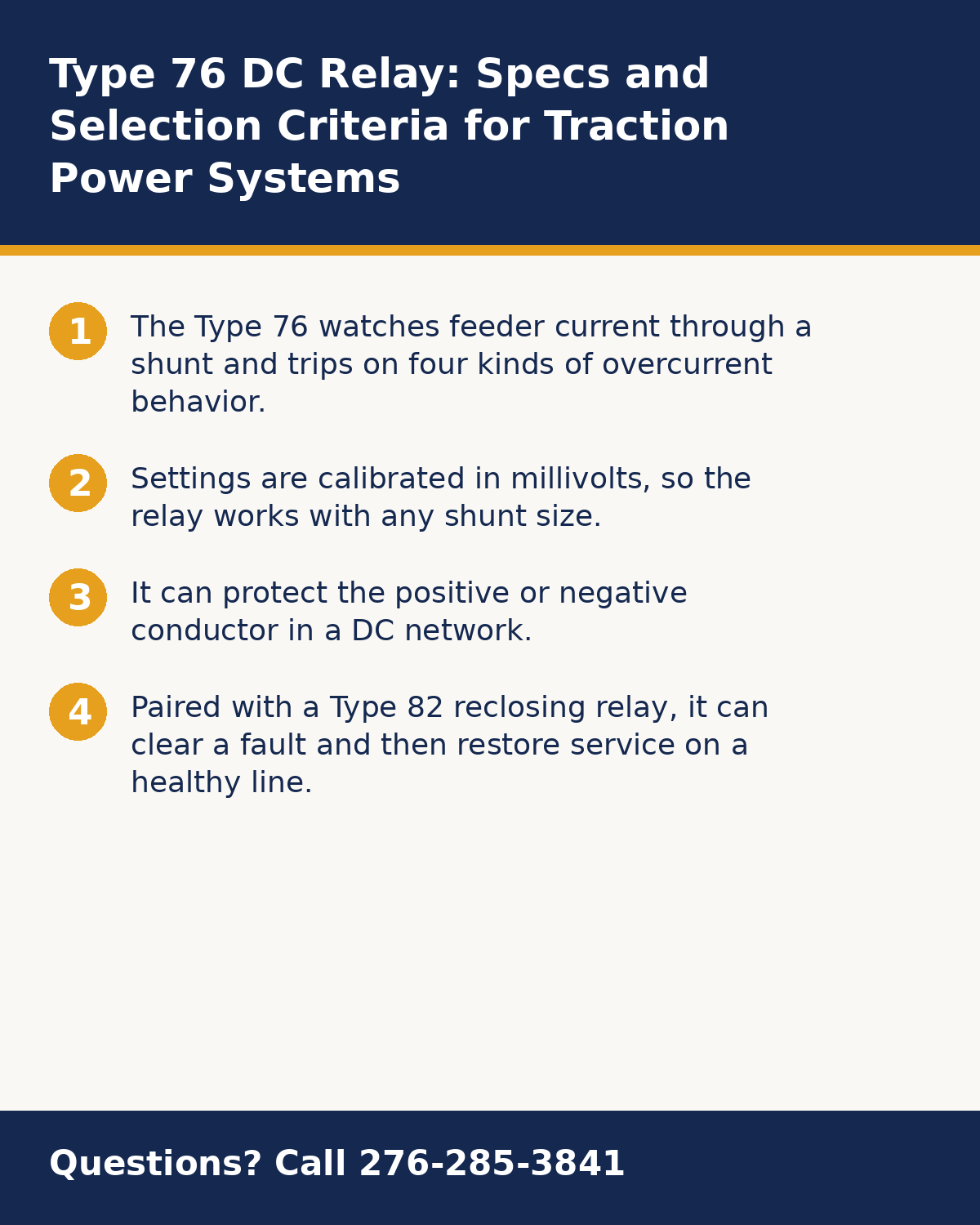
The Type 76 doesn't measure amps directly. It reads the tiny voltage drop across a shunt, which is a precise, low-value resistor sitting in the feeder. Current through the shunt makes a few millivolts of drop.
Because the front panel controls are calibrated in millivolts, the relay works with any shunt size. Customers like hearing that, because it usually means they can keep their existing shunts.
Two notes we'd put in any spec, though. Keep shunt wiring shielded and short, since the signal is so small. And check shunts against a calibrated reference during maintenance, because they can drift if they overheat or a connection loosens.
GET IN TOUCH
The ultimate solution for reliable power control! call us at 276-285-3841
Four detector channels watching at once
The relay has four detector channels, and all four watch the same millivolt signal at the same time.
The instant channel trips on very high current with no added delay. Its range is 10 to 300 mV, and it handles close-in bolted faults right outside the substation.
The short-term channel trips when current stays raised for a short time. Its range is 10 to 110 mV, and it catches faults farther down the line.
The long-time channel watches for sustained overload that would cook a feeder.
And then there's rate of rise. This is the one people call us about.
Rate of rise is the answer to the hill
When a train accelerates, its propulsion controls ramp current up over a fraction of a second or longer. A short circuit climbs much more sharply, held back mostly by the circuit's inductance and resistance.
The rate of rise channel looks at the slope of the current as well as its size, and trips when the slope is steeper than the setting.
So two trains climbing a grade make a big current with a gentle slope. An arcing insulator two miles out makes a similar current with a steep slope. The relay can tell them apart, which your old electromechanical relays often can't.
Where does that setting go?
Everyone wants a number here. We don't hand one out over the phone, and honestly nobody should.
You need a study. Model the substation, feeder cables and rail. Calculate how fast fault current rises at points along the line, including the far end of each section. Then compare those rates with real rush-hour data from your event recorders.
The setting goes between the two, with margin on both sides.
We'd suggest putting that study in the project plan as its own line item, so it doesn't get squeezed.
The practical questions
These usually go quickly.
Which conductor? The type 76 DC relay can be field-set for unidirectional or bidirectional mode, and installed on either the positive or the negative conductor in a DC network.
Control power? The internal supply accepts a range of DC inputs and compensates for that range on its own, so most station batteries work as they are.
Testing? Draw-out construction lets technicians slide the relay out of its case for bench testing without lifting wires in the panel. Front panel calibration controls let crews set thresholds and time delays on site during commissioning.
Maintenance supervisors tend to smile at that last part. They've usually been fighting old relays on it for years.
After it trips, then what?
This question doesn't get asked enough.
On its own, an overcurrent relay opens the breaker, and the breaker stays open until someone resets it. If your line has overhead wire and trees, that adds up. Every time a branch brushes the wire and falls clear, a crew drives out through traffic to close a breaker by hand.
That's why most transit feeders pair the Type 76 with our Type 82 DC reclosing relay. The Type 82 tests the line after a trip and closes again only when the fault is gone. It uses SWARTZ transducers that feed it scaled bus voltage.
If you're writing a spec for the Type 76, it's worth deciding on reclosing at the same time.
Commissioning
When the relays arrive, your crew installs them, enters the study settings and runs secondary tests to confirm each channel picks up where it should.
Prove the trip circuit all the way to the breaker before the line goes back into service. We can't say that strongly enough.
What success looks like
The good result is pretty quiet. A section insulator flashes over during a storm, and the rate of rise channel trips the feeder in a fraction of a second. The next morning, two trains climb the hill side by side, and the feeder stays closed.
We can help you review settings and test plans when adding a type 76 DC relay to a system or updating an existing one. You can see the full feature list on our Type 76 DC relay product page, and our article on common issues in railway DC distribution systems covers the faults these relays are built to catch.
GET IN TOUCH
The ultimate solution for reliable power control! call us at 276-285-3841
Ready to Spec a Relay?
Call Swartz Engineering at 276-285-3841 or contact our team with your feeder voltage, shunt rating and breaker details. We will help you match the Type 76 settings to your system. You can also browse all of our traction power products.
Frequently Asked Questions
Q: Can a Type 76 DC relay work with my existing shunts?
A: Yes. The front panel controls are calibrated in millivolts, so the relay works with any type of shunt.
Q: Does it protect positive and negative conductors?
A: It can be used on either the positive or the negative conductor in a DC power distribution network.
Q: How does the rate of rise channel distinguish a train starting from a short circuit?
A: It evaluates how quickly current increases, as well as the current level. Train acceleration typically causes a more gradual rise, while a short circuit can produce a steeper increase. The rate of rise setting should be based on a system study and real operating data.
Q: Can technicians test the Type 76 without disconnecting panel wiring?
A: Its draw-out construction lets technicians remove the relay from its case for bench testing without lifting the panel wires. During commissioning, crews should also verify that the trip circuit operates all the way to the breaker.
Q: Does the Type 76 automatically reclose the breaker after a trip?
A: No. The Type 76 opens the breaker, which stays open until it is reset. A Type 82 DC reclosing relay can be paired with it to test the line and reclose the breaker when the fault has cleared.
Products We Offer
Swartz Engineering strives to provide top-quality products to achieve our customer's needs. Our products include:
- Type 76 DC Relay
- Type 82 DC Relay
- Swartz Engineering’s Type 64 Ground Relay
- Type 32 Reverse Current Relay
- Type 150 DC
- CSM Shield Monitor
- Metal Oxide Surge Arrestors
- Transducers
- MVIS SL Slim-line Contactor
- Fully-tested Power Control Rooms
- Swartz Engineering’s Portable Substations
For nearly half a century, we have proudly led the industry in ensuring safety and efficiency. Swartz Engineering is a trusted family-owned company dedicated to providing top-notch power distribution solutions for the electrical industry. Contact us today.