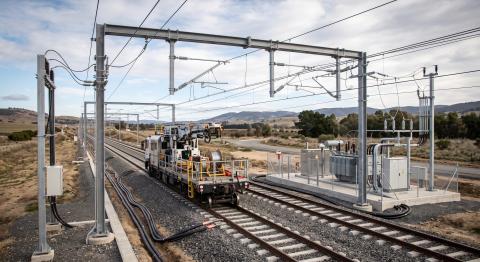
An electric train does not rely on one piece of equipment for power. Its train power source is part of a larger electrical system that begins with utility power, conditions the electricity for railway use, distributes it along the route, and protects the network when faults occur.
Depending on the railway, trains may receive electricity through overhead contact lines or a third rail. Behind those conductors are traction power substations, transformers, rectifiers where DC conversion is required, switchgear, protection devices, controls, and monitoring systems.
At Swartz Engineering, we work within this critical power-distribution environment. Understanding how these pieces interact is important because reliable rail electrification depends on much more than simply getting electricity to the track.
Key Takeaways
- A train power source includes the electrical infrastructure that converts, protects, controls, and distributes utility power for railway traction.
- Overhead systems and third rails are delivery methods; traction substations provide the electrical conversion and distribution needed upstream.
- AC and DC railways require different substation arrangements, protection strategies, and equipment.
- Switchgear and protective relays help isolate faults while allowing unaffected portions of a rail power network to remain available where system design permits.
- Rail power equipment must handle demanding operating conditions, including heavy traction loads, short circuits, voltage changes, and transient events.
- Reliable electrification depends on treating substations, distribution, protection, controls, and current collection as one coordinated system.
What Is a Train Power Source?
A train power source is the electrical supply system that provides usable traction power to an electric train. In an externally powered railway, electricity normally originates from the utility grid and passes through rail-specific conversion and distribution equipment before reaching the train.
The basic power path looks like this:
Utility grid → traction power substation → distribution system → overhead line or third rail → train → return circuit
The Federal Railroad Administration recognizes overhead catenary systems among the technologies used for railroad electrification, while rail systems may also use third-rail arrangements depending on their operating requirements.
The important distinction is that an overhead wire or third rail is not the entire power source. It is the final distribution interface between the fixed electrical infrastructure and the moving train.
How Does Rail Electrification Deliver Power to a Train?
Rail electrification delivers electricity to trains through a coordinated chain of substations, conductors, switching equipment, protection devices, and onboard collection equipment.
For overhead electrification, electrical energy is supplied to an overhead contact system. A roof-mounted pantograph maintains contact with the energized conductor and transfers power into the train.
A third-rail system places an energized conductor alongside the running rails. Instead of a pantograph, the vehicle uses a collector shoe or similar contact device to draw current from the rail.
Which arrangement makes sense depends on the railway's operating environment, voltage, train type, clearance requirements, route characteristics, legacy infrastructure, and other engineering constraints.
That is why there is no universal train power source design that fits every rail network.
Why Are Traction Power Substations Essential?
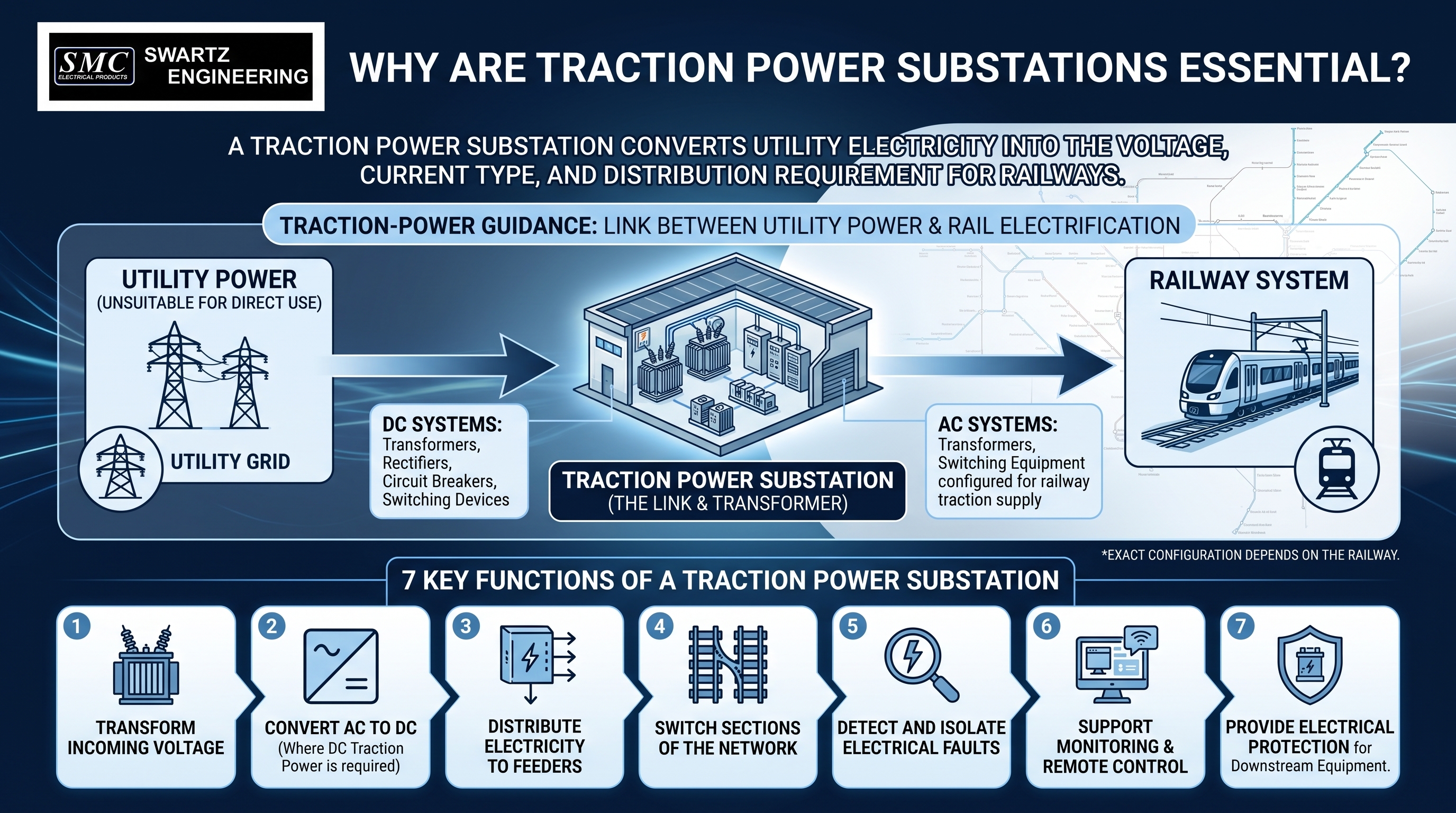
A traction power substation converts incoming electrical power into the voltage, current type, and distribution arrangement required by the railway.
Utility electricity generally cannot be sent directly to trains without being transformed, controlled, and protected first.
Swartz Engineering's traction-power guidance describes substations as the link between utility power and rail electrification systems. For DC systems, typical equipment can include transformers, rectifiers, circuit breakers, and switching devices. AC systems rely on transformers and switching equipment configured for the railway's required traction supply.
A traction substation may therefore perform several functions:
- transform incoming voltage;
- convert AC to DC where the railway requires DC traction power;
- distribute electricity to feeders;
- switch sections of the network;
- detect and isolate electrical faults;
- support monitoring and remote control; and
- provide electrical protection for downstream equipment.
The exact configuration depends on the railway.
GET IN TOUCH
The ultimate solution for reliable power control! call us at 276-285-3841
AC vs. DC Train Power Source Systems
Rail electrification commonly uses either alternating current or direct current, and the choice changes how the fixed infrastructure is designed.
|
|
|
|
|
|
|
|
|
|
|
|
|
|
|
|
The FRA's Northeast Corridor planning documents, for example, discuss rolling stock operating with catenary, third-rail, and dual-power arrangements, illustrating how compatibility can become a significant issue where different electrification systems meet.
The question, therefore, is not simply whether AC or DC is “better.” Engineers have to consider the existing network, route length, service pattern, equipment compatibility, electrical losses, train demands, maintenance strategy, and infrastructure already in place.
How Overhead Line Equipment Supplies Train Power
Overhead Line Equipment, often called OLE or an overhead contact system, distributes electrical power above the track.
The train's pantograph maintains sliding electrical contact with the overhead conductor while the train moves. The current then passes through the train's electrical equipment to the traction motors and other systems that require power.
Higher-voltage AC electrification is particularly useful where power must be transmitted efficiently across substantial distances. Systems using voltages such as 25 kV AC are common examples of modern railway electrification, although actual voltage and frequency depend on the network. Swartz Engineering notes that rail power systems can use arrangements such as 25 kV AC as well as lower-voltage DC systems.
Overhead electrification also places demands on the supporting power network. Substations, feeder arrangements, breakers, protection, controls, and switching equipment must all work together with the contact system.
How Third-Rail Power Systems Work
A third-rail system supplies electrical power through an energized conductor installed beside the running rails.
A collector shoe mounted on the train makes contact with the conductor rail and transfers electricity into the vehicle. Third-rail installations are commonly associated with urban and metro systems, particularly where overhead clearances or existing infrastructure make an overhead system less practical.
These systems usually operate at lower voltages than high-voltage overhead AC systems. That means current levels and substation spacing can become important design considerations.
For a DC third-rail railway, the upstream train power source commonly includes transformers and rectifiers that convert incoming utility power into the required DC supply. Protective switchgear then controls feeders and helps isolate electrical faults.
Why Switchgear Matters in Rail Electrification
Switchgear allows operators to control, isolate, and protect sections of a traction power system.
That becomes especially important in rail service because an electrical problem should be detected and cleared before it damages equipment or creates a wider disruption.
In railway substations, switchgear can help manage distribution circuits and isolate equipment for maintenance. Rail applications can also require protection against overloads, short circuits, and other abnormal electrical conditions. Swartz Engineering supplies DC switchgear for applications including train traction power and describes circuit breakers, disconnect devices, fuses, and surge protection among the equipment used to manage DC power systems.
The protection strategy needs to distinguish between genuine electrical faults and the demanding but normal current associated with railway operation.
A train accelerating away from a station, for example, can place a very different load on the traction network than a train moving steadily along the route. Protection equipment must be engineered around those operating characteristics rather than treated like ordinary building distribution equipment.
Protection Is Part of the Train Power Source
Reliable rail electrification depends on more than supplying enough current. The network also needs to respond correctly when something goes wrong.
Protective equipment may be used to monitor current, voltage, rate-of-rise conditions, reverse current, ground faults, and other electrical conditions depending on the system design.
For example, Swartz Engineering's Type 150 DC rate-of-rise relay is designed for transit applications and protects trolley wires, third rails, feeders, and substations against conditions including overloads and electrical faults while accounting for normal train-starting loads.
This distinction matters.
If protection operates too slowly, equipment may remain exposed to a damaging fault. If it operates unnecessarily during normal train acceleration or other expected conditions, service availability can suffer.
Protection therefore has to match the electrical behavior of the railway it serves.
How Do Engineers Choose the Right Train Power Source Solution?
The right solution depends on the railway rather than on one preferred technology.
For a new system, engineers can evaluate the most appropriate voltage, current type, substation layout, and current-collection method around the intended service. An existing railway presents a different challenge because new equipment may need to work with legacy infrastructure that has been operating for decades.
Important design questions include the route's traction demand, spacing of trains, AC or DC requirements, overhead or third-rail collection, fault levels, redundancy needs, maintainability, environmental exposure, available space, utility connection, control architecture, and compatibility with existing equipment.
The Federal Railroad Administration's recent work on railway electrification reflects this broader approach. Its 2025 research evaluates electrification through a framework that considers technologies, operating strategies, costs, benefits, uncertainty, and risk rather than treating electrification as a single equipment decision.
That system-level thinking is essential. A transformer, breaker, relay, rectifier, or control panel may perform one specific task, but reliable train operation depends on how those devices function together.
Designing Rail Power Infrastructure for Harsh Environments
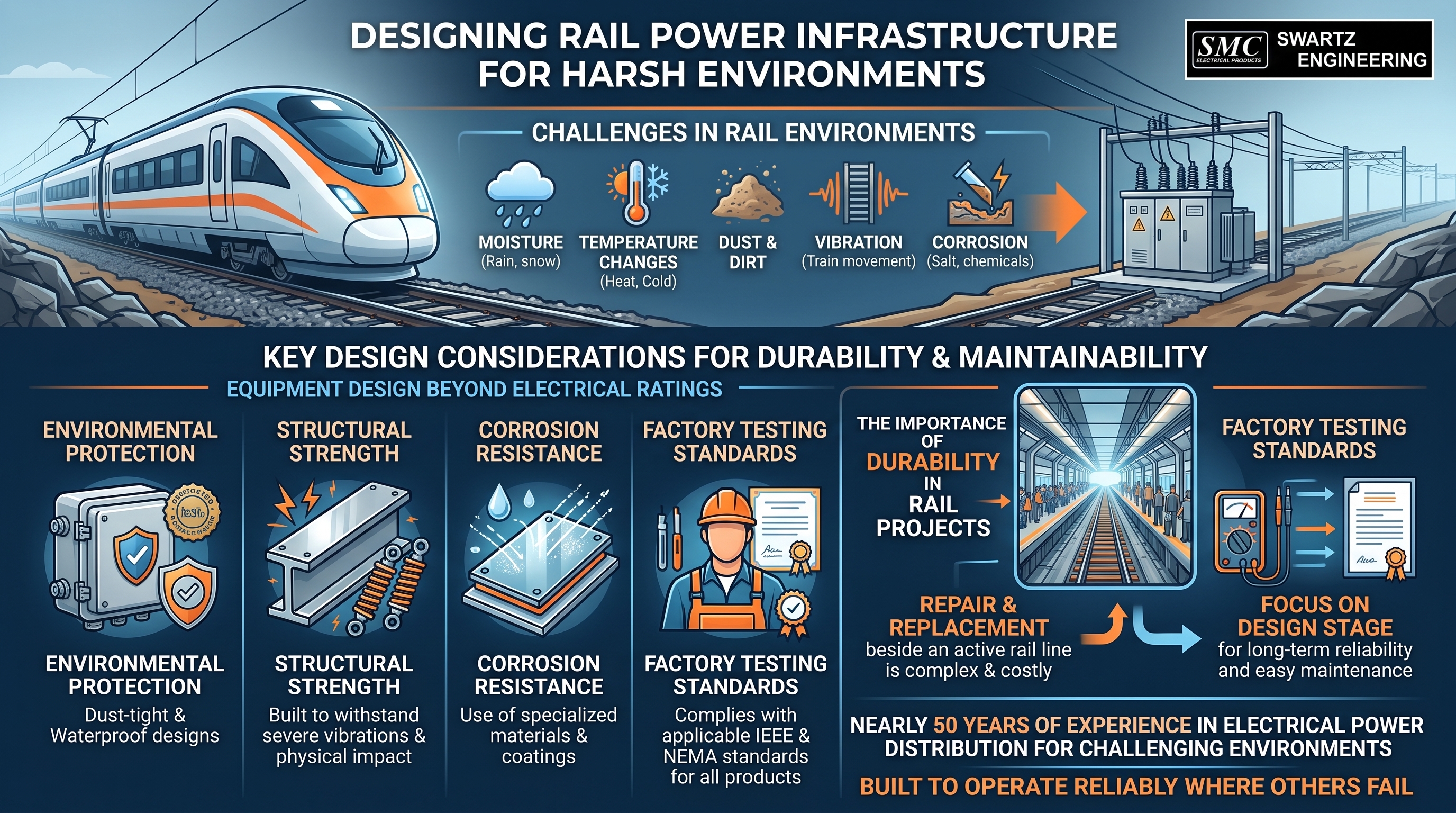
Rail electrical equipment may operate outdoors or in infrastructure exposed to moisture, temperature changes, dust, vibration, corrosion, and other demanding conditions.
Equipment design therefore has to account for more than electrical ratings.
At Swartz Engineering, we design and build power-distribution equipment for challenging environments. Our company has nearly half a century of history in electrical power distribution, and our products are engineered with environmental protection, structural strength, and corrosion resistance in mind. Our factory testing follows applicable IEEE and NEMA standards for the products involved.
For rail projects, those considerations matter because replacing or repairing equipment beside an active transportation corridor can be significantly more complicated than servicing equipment in an ordinary commercial building.
Durability and maintainability need to be considered at the design stage.
GET IN TOUCH
The ultimate solution for reliable power control! Call us at 276-285-3841
Building a More Reliable Rail Electrification System
A reliable train power source comes from coordinating conversion, distribution, switching, protection, monitoring, and current collection.
The visible part of electrification may be the overhead wire or third rail. The infrastructure behind it is what makes dependable operation possible.
A well-engineered traction power system should deliver the required electricity to trains while also giving operators the ability to isolate faults, perform maintenance, monitor electrical conditions, and protect expensive equipment.
At Swartz Engineering, our work in electrical power distribution includes equipment and solutions for traction-power environments, including DC switchgear, protection relays, transducers, surge protection, power control rooms, and substation-related applications.
For rail operators, consultants, contractors, and project teams, the strongest solution starts by looking at the entire electrical system rather than selecting individual products in isolation.
Talk With Swartz Engineering About Rail Power Distribution
Rail electrification works best when the power system is treated as one connected network.
If your project requires traction-power protection, switching, monitoring, control, or related power-distribution equipment, we can help evaluate the electrical requirements and identify equipment suited to the application.
Contact Swartz Engineering to discuss your rail power project.
Frequently Asked Questions
Q: What is the main power source for an electric train?
A: The immediate power source is electricity supplied through an overhead contact line or third rail. Upstream, utility electricity passes through traction-power infrastructure that transforms, converts, controls, protects, and distributes it at the voltage and current type required by the railway.
Q: What is the purpose of a traction power substation?
A: A traction power substation adapts utility electricity for railway use. Depending on the rail system, it may transform voltage, convert AC to DC, distribute power to feeders, provide switching, and support system protection and monitoring.
Q: Do all electric trains use overhead wires?
A: No. Electric trains can receive power through overhead conductors or third-rail systems. Some rolling stock can also operate across more than one power arrangement where the network requires it.
Q: What is the difference between AC and DC railway power?
A: AC rail systems deliver alternating current to the train, while DC systems supply direct current. A DC traction substation commonly uses a transformer followed by a rectifier to convert utility AC into the required DC supply. AC traction substations generally transform the incoming utility supply to the voltage and configuration required by the railway.
Q: Why is protection equipment important in rail electrification?
A: Protection equipment detects abnormal electrical conditions and helps isolate faults before they cause wider damage. Rail protection must also accommodate normal operating events such as high current during train acceleration, making application-specific coordination important.
Q: What equipment does Swartz Engineering provide for traction-power applications?
A: Our published product range includes DC switchgear, protection relays, transducers, metal-oxide surge arresters, power control rooms, portable substations, and other power-distribution equipment relevant to transit and industrial electrical systems.
Products We Offer
Swartz Engineering strives to provide top-quality products to achieve our customer's needs. Our products include:
- Type 76 DC Relay
- Type 82 DC Relay
- Swartz Engineering’s Type 64 Ground Relay
- Type 32 Reverse Current Relay
- Type 150 DC
- CSM Shield Monitor
- Metal Oxide Surge Arrestors
- Transducers
- MVIS SL Slim-line Contactor
- Fully-tested Power Control Rooms
- Swartz Engineering’s Portable Substations
For nearly half a century, we have proudly led the industry in ensuring safety and efficiency. Swartz Engineering is a trusted family-owned company dedicated to providing top-notch power distribution solutions for the electrical industry. Contact us today.