
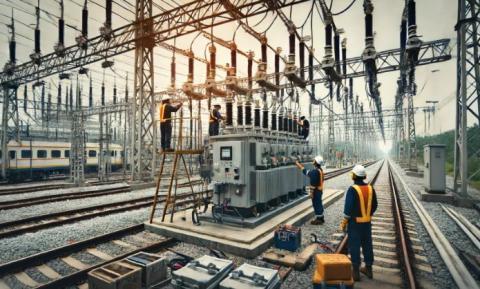
Railway electrical systems operate in an environment where a short voltage spike can affect equipment responsible for power distribution, signaling, communications, or train movement. An industrial surge protector helps limit that risk by controlling transient overvoltages before excessive electrical energy reaches vulnerable equipment.
In railway applications, surge protection is more complicated than plugging sensitive electronics into a conventional surge strip. Rail systems include long conductors, outdoor equipment, DC traction power, signal circuits, communications networks, substations, and equipment exposed to lightning and switching events. The correct protection therefore depends on the circuit, operating voltage, installation point, grounding arrangement, and equipment being protected.
At Swartz Engineering, we specialize in electrical power distribution equipment designed for demanding industrial and transportation environments. Our surge protection products include metal oxide surge arrestors intended for DC distribution systems in transit and other industrial applications.
Key Takeaways
- An industrial surge protector limits transient voltage before it can damage or disrupt sensitive railway electrical and electronic equipment.
- Railway surge protection may be needed at substations, DC feeders, signaling equipment, trackside installations, communications interfaces, and vehicles.
- The right device cannot be selected by surge rating alone; system voltage, MCOV, circuit type, grounding, location, and expected exposure all matter.
- Protection for railway signal systems may require multiple coordinated stages rather than one surge device at a single point.
- UL, IEEE, and AREMA guidance can all be relevant, but the applicable standard depends on the type of circuit and surge-protection equipment involved.
What Is an Industrial Surge Protector?
An industrial surge protector is a device designed to limit transient overvoltage and prevent excessive surge energy from reaching electrical or electronic equipment.
A transient is a brief electrical disturbance rather than a sustained change in normal system voltage. It may result from lightning, switching operations, faults, or electrical events elsewhere in an interconnected system.
During normal conditions, the surge-protection device has little or no effect on the circuit. When voltage rises beyond its intended operating range, the protective device provides a controlled path or otherwise limits the transient so the protected equipment sees a lower electrical stress.
That basic principle applies across many industries. Railway applications, however, introduce conditions that make device selection and installation more demanding.
Why Do Railways Need Industrial Surge Protection?
Railways need industrial surge protection because critical electrical systems are spread across long distances and often operate in exposed environments.
A signal bungalow, grade-crossing installation, traction substation, catenary system, track circuit, communications line, or piece of onboard equipment may be connected to conductors that provide a path for surge energy.
Lightning is one source, but it is not the only one. Electrical switching and faults can also create transient disturbances. IEEE's current C62.41.2 recommended practice describes surges on low-voltage AC circuits as disturbances capable of causing equipment damage or operational upset, including events appearing on line, neutral, or grounding conductors.
That distinction matters in rail applications. A surge does not always destroy equipment immediately. Electrical stress can also interrupt operation or contribute to component degradation, creating a reliability problem before a complete failure occurs.
Where Are Surge Protectors Used in Railway Systems?
The exact protection points depend on the railway system, but surge protection can be applied anywhere damaging transient energy has a realistic path into critical equipment.
Traction Power and DC Distribution
Electrified railway systems depend on equipment that distributes large amounts of electrical power. Rectifiers, substations, feeders, catenary systems, power rails, and vehicle electrical systems can all be exposed to transient conditions.
Swartz Engineering's SMC Metal Oxide Surge Arrestors are specifically designed for DC distribution systems used in transit, industrial, and mining applications. They may be mounted on rectifiers, substations, DC feeders, catenary poles, at the power rail, or on a vehicle.
For these applications, selecting a device simply because it is described as "industrial grade" is not enough. Its electrical characteristics must match the actual DC system.
Wayside Signaling and Trackside Equipment
Railway signaling equipment frequently sits in exposed locations connected through track circuits, power conductors, control wiring, and other interfaces.
A surge reaching a signal enclosure can affect more than a replaceable electronic component. It may create a loss of communication, false indication, equipment lockout, or other operational problem that requires investigation before normal service can resume.
AREMA's Communications & Signals guidance specifically addresses the surge withstand capability of electronic railroad signal equipment connected to track circuits, line circuits, and AC or DC power circuits. Its 2025 guidance recommends staged or multiple levels of protection for applicable electronic equipment in signal enclosures and train control rooms.
That system-level approach is important. Protecting only one incoming conductor may leave another path exposed.
Communications and Data Circuits
Modern railway operation depends heavily on data transmission. Communications, monitoring equipment, train-control interfaces, and other electronic networks may use circuits that cannot be treated the same way as traction power conductors.
Surge protection for an information or communications circuit must limit damaging electrical stress without interfering with the circuit's normal function.
IEEE C62.43.1 addresses the application of surge protectors and protective circuits on information and communication technology circuits. It is separate from the standards used for stand-alone AC power protection, reinforcing an important engineering point: different circuit types can require different protection methods.
Onboard Railway Equipment
Surge protection can also be used on vehicles. Locomotives and railcars increasingly depend on electronic control, monitoring, auxiliary power, communications, and propulsion-related systems.
The appropriate protection depends on how a transient can enter the equipment and on the electrical characteristics of the onboard system. A device designed for a wayside AC power panel is not automatically suitable for a DC traction circuit or onboard installation.
How Does an Industrial Surge Protector Work?
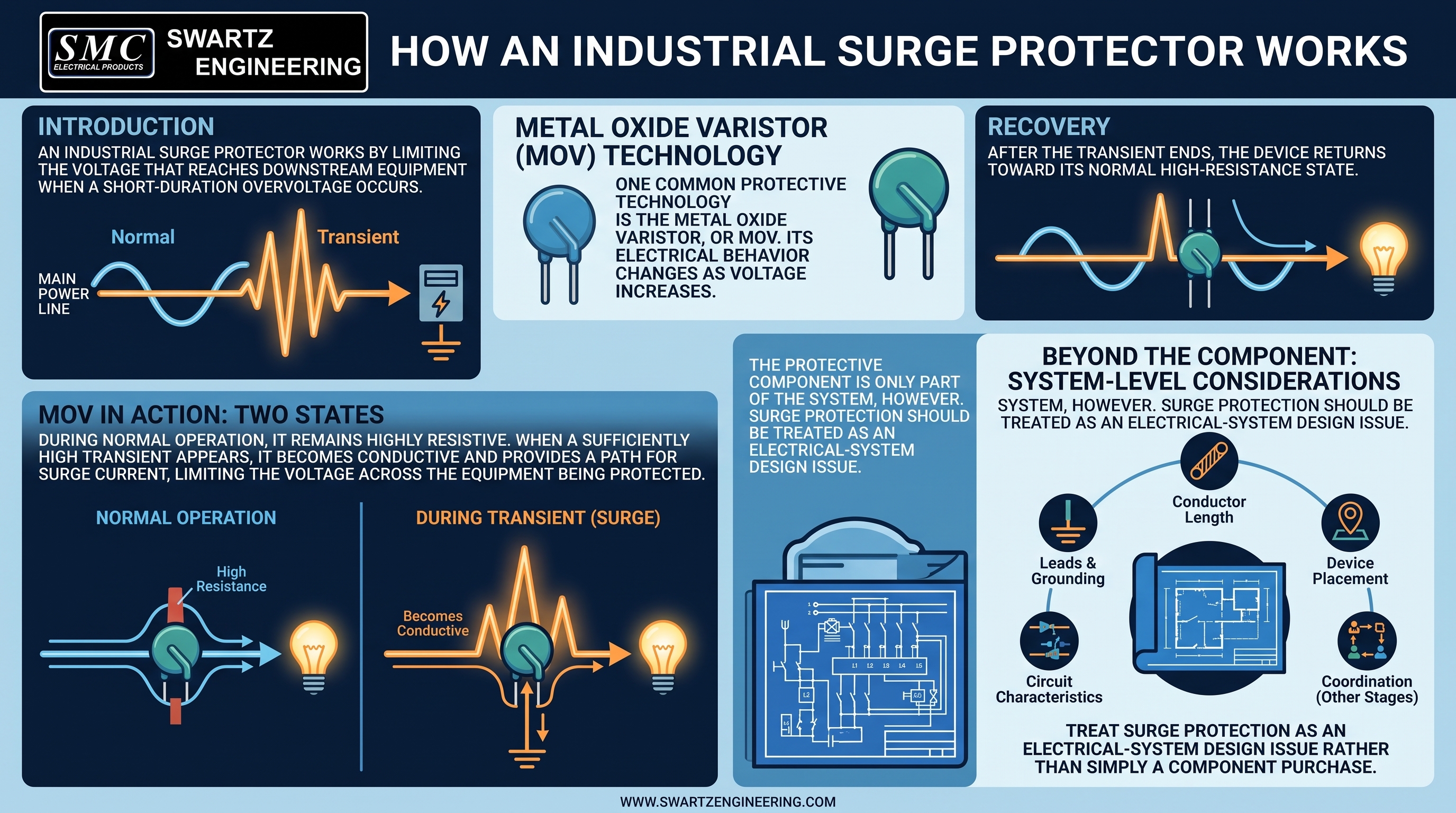
An industrial surge protector works by limiting the voltage that reaches downstream equipment when a short-duration overvoltage occurs.
One common protective technology is the metal oxide varistor, or MOV. Its electrical behavior changes as voltage increases. During normal operation, it remains highly resistive. When a sufficiently high transient appears, it becomes conductive and provides a path for surge current, limiting the voltage across the equipment being protected.
After the transient ends, the device returns toward its normal high-resistance state.
The protective component is only part of the system, however. Leads, grounding, conductor length, device placement, coordination with other protection stages, and the characteristics of the protected circuit can all influence the voltage that ultimately appears at the equipment terminals.
For that reason, surge protection should be treated as an electrical-system design issue rather than simply a component purchase.
GET IN TOUCH
The ultimate solution for reliable power control! call us at 276-285-3841
Surge Protector vs. Surge Arrestor: Is There a Difference?
The terms are sometimes used loosely, but an industrial surge protector and a surge arrestor are not always interchangeable product classifications.
"Surge protective device," or SPD, is a broad term used for equipment intended to limit transient surges. UL 1449, for example, covers specified types of SPDs used on 50- or 60-Hz power circuits up to 1,000 volts as well as certain photovoltaic DC applications.
Surge arrestors are commonly associated with power systems and may serve different voltage classes and applications. UL itself distinguishes UL 1449 surge protective devices from surge arresters used above 1,000 volts in its lightning-protection guidance.
For a railway project, terminology should therefore follow the actual equipment, circuit, specification, and governing engineering requirements rather than assuming every surge-control product belongs to the same category.
How Do You Choose an Industrial Surge Protector for a Railway?
Choosing a railway surge-protection device starts with the electrical system, not with the largest surge-current number on a datasheet.
The engineer or specifier should first identify the normal circuit voltage and whether the application is AC power, DC traction power, signaling, communications, or another circuit type. From there, the protective device must have electrical ratings appropriate for continuous operation on that circuit.
For Swartz Engineering's metal oxide surge arrestors, selection is based on maximum continuous operating voltage, or MCOV. MCOV is the maximum voltage the arrestor is intended to withstand continuously without operating as though a surge were occurring.
Installation location also matters. Swartz recommends mounting its arrestor as close as possible to the device it protects and using a conductor sized appropriately for the anticipated surge. Where the unit is grounded, Swartz specifies a connection of less than 5 ohms for this product.
These details illustrate why a generic "industrial grade" label tells an engineer very little by itself. A suitable device needs to match the circuit and installation.
Why Does Placement Matter?
A surge protector cannot completely control what protected equipment experiences if the installation adds unnecessary impedance between the protector and the equipment or grounding path.
During a fast transient, conductor length and routing become important. Excessively long connections can contribute additional voltage during the surge event.
This is one reason protection is commonly installed close to the equipment or at the point where an external circuit enters an enclosure.
In signal systems, AREMA goes a step further by recommending staged protection in appropriate applications. Primary protection is placed near the entrance point to take the brunt of the exposure, followed by secondary protection and tertiary protection associated with the electronic equipment.
In other words, one large protector located somewhere upstream may not provide the same protection as a coordinated system designed around the actual paths a transient can take.
What Standards Apply to Railway Surge Protection in the USA?
There is no single standard that covers every surge-protection device used everywhere on a railway. The relevant requirements depend on the circuit, product, installation, railway specification, and application.
UL 1449 applies to defined categories of surge protective devices, including devices intended for repeated limiting of transient voltage surges on specified low-voltage power circuits. The current UL 1449 scope covers 50- or 60-Hz circuits up to 1,000 volts and specified photovoltaic DC applications up to 1,500 volts.
IEEE C62 standards and guides address different parts of surge characterization, testing, and protection. IEEE C62.41.2-2025, published in July 2026, characterizes the surge environment on low-voltage AC power circuits through standardized waveforms and stress parameters. IEEE C62.43.1 addresses surge protection for information and communication technology circuits.
AREMA's Communications & Signals Manual contains railway-specific recommended practices related to signal-system electrical surge protection and surge withstand capability. Current AREMA material specifically addresses electronic signal equipment connected to track, line, and AC or DC power circuits and recommends coordinated levels of protection in certain installations.
Project specifications, railroad requirements, electrical codes, and equipment-manufacturer instructions may add further requirements. Those should be reviewed for the actual installation rather than assuming one standard covers the entire rail network.
What Can Go Wrong With Poorly Applied Surge Protection?
A surge protector can have an adequate published rating and still provide poor system protection if it is applied incorrectly.
A device with the wrong operating voltage may not behave correctly on the circuit. Long leads can reduce the effectiveness of the installation. A weak grounding path can raise the voltage seen by connected equipment. Protecting power wiring while leaving signal or communications conductors unprotected can create another path for surge energy.
There is also a coordination issue. If several protective devices are used throughout a system, they should work as a protection scheme instead of behaving as unrelated components.
This is particularly important in railway systems because electrical, control, communications, grounding, and trackside infrastructure often interact.
Industrial Surge Protection Is Part of Railway Reliability
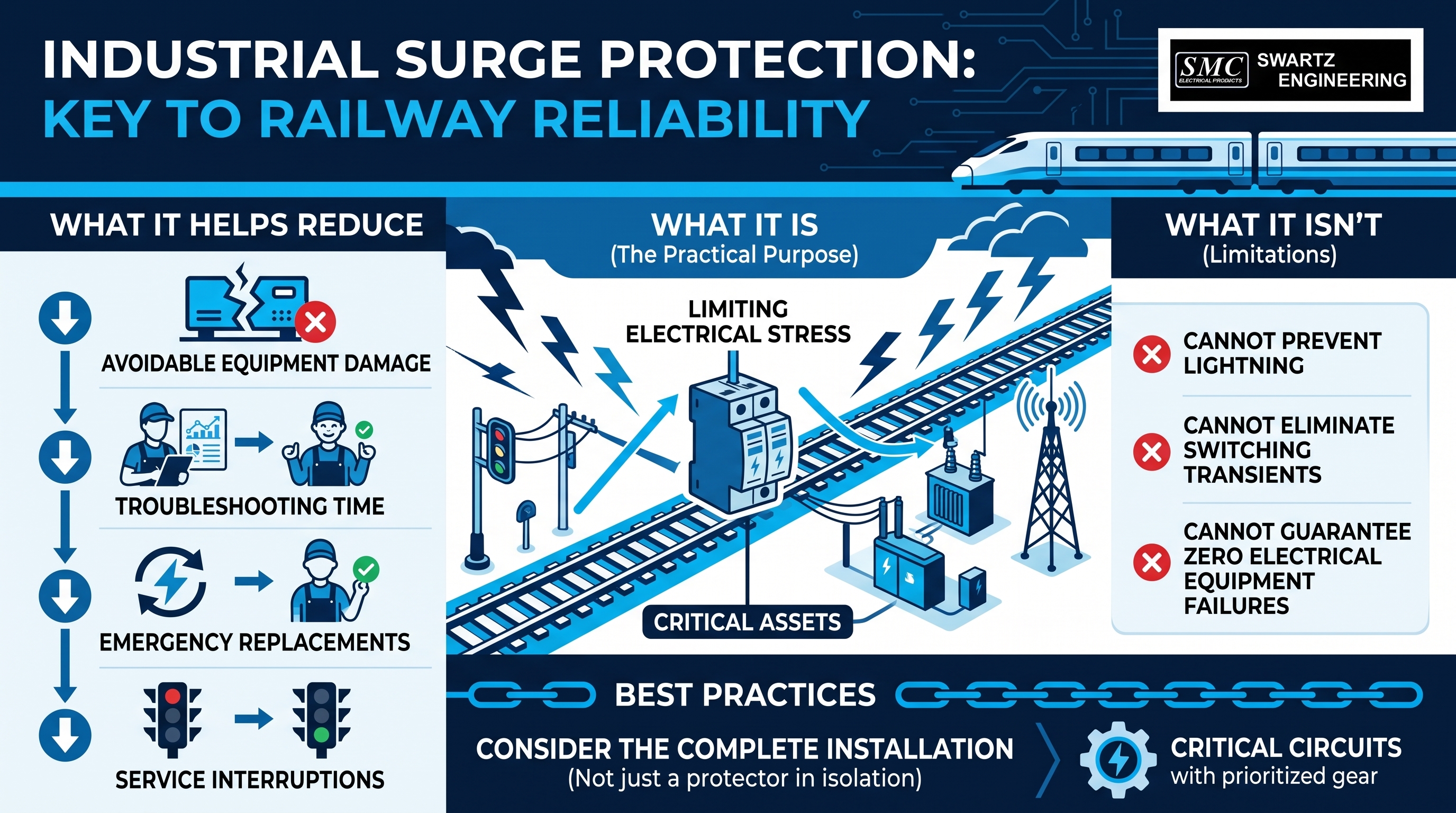
A railway surge-protection system cannot prevent lightning, eliminate switching transients, or guarantee that electrical equipment will never fail. Its purpose is more practical: limit the electrical stress reaching critical assets and give the system a better chance of remaining operational after transient events.
That can help reduce avoidable equipment damage, troubleshooting, emergency replacements, and service interruptions.
The more critical the protected circuit, the more important it becomes to consider the complete installation rather than selecting a protector in isolation.
GET IN TOUCH
The ultimate solution for reliable power control! call us at 276-285-3841
How Swartz Engineering Supports Railway Surge Protection
At Swartz Engineering, we have specialized in power distribution for the electrical industry for nearly half a century. Our equipment is designed for demanding operating environments, and our product range includes electrical distribution, control, relay, substation, and surge-protection equipment.
For DC transit applications, our SMC Metal Oxide Surge Arrestors provide protection for distribution systems and can be installed at locations including rectifiers, substations, feeders, catenary poles, power rails, and vehicles.
The correct solution depends on what you are protecting. System voltage, MCOV, grounding, installation location, expected surge exposure, and the requirements of the railway or project specification should all be evaluated before a device is selected.
If you need surge protection for a railway power-distribution project, contact us to discuss the electrical system and application requirements.
Frequently Asked Questions
What does an industrial surge protector do on a railway?
An industrial surge protector limits transient overvoltage before excessive electrical energy reaches railway equipment. Depending on the installation, it may protect power distribution, signaling, communications, trackside electronics, or onboard electrical systems.
Can one surge protector protect an entire railway system?
Usually not. Railway systems contain multiple power, signaling, control, and communications circuits spread across different locations. Protection often needs to be installed at several points, and AREMA guidance recommends staged protection for certain railroad signal-system applications.
What causes electrical surges on railways?
Possible sources include lightning, switching operations, faults, and disturbances transferred through connected conductors. Outdoor equipment and long interconnected electrical paths can increase the number of ways a transient reaches sensitive equipment.
Are railway surge protectors the same as household surge strips?
No. A household surge strip is intended for relatively simple point-of-use applications. Railway surge protection is selected around specific circuit voltages, system architecture, grounding, environmental exposure, and engineering requirements.
What is MCOV in surge protection?
MCOV means maximum continuous operating voltage. It identifies the voltage a surge-protection device can continuously withstand under normal operating conditions. Swartz Engineering uses MCOV as the basis for selecting its SMC Metal Oxide Surge Arrestors.
Does every railway surge protector need to meet UL 1449?
Not necessarily. UL 1449 covers particular categories of surge protective devices within its defined scope. Railway systems also use DC traction equipment, signal circuits, communications circuits, and other equipment that may fall under different standards or project requirements. Device selection should be based on the actual circuit and applicable specifications.
Products We Offer
Swartz Engineering strives to provide top-quality products to achieve our customer's needs. Our products include:
- Type 76 DC Relay
- Type 82 DC Relay
- Swartz Engineering’s Type 64 Ground Relay
- Type 32 Reverse Current Relay
- Type 150 DC
- CSM Shield Monitor
- Metal Oxide Surge Arrestors
- Transducers
- MVIS SL Slim-line Contactor
- Fully-tested Power Control Rooms
- Swartz Engineering’s Portable Substations
For nearly half a century, we have proudly led the industry in ensuring safety and efficiency. Swartz Engineering is a trusted family-owned company dedicated to providing top-notch power distribution solutions for the electrical industry. Contact us today.