Modern rail transport throughout the United States demands continuous, high-capacity electrical distribution to keep trains moving safely and efficiently. Heavy freight routes, passenger corridors, and industrial yards face strict regulations and tough environmental conditions. Installing a custom railway power supply system allows rail operators to eliminate unexpected operational downtime, maintain voltage stability across hundreds of miles of track, and support future infrastructure expansion.
Key Takeaways
- System Reliability: Engineered substations prevent unexpected grid trips and dangerous voltage sags.
- Operational Efficiency: Specialized gear cuts internal power losses and lowers long-term operational overhead.
- Safety Compliance: Strict grounding and protective relaying protect maintenance crews and rail equipment.
- Scalable Infrastructure: Modular designs accommodate future load demands without requiring complete system retrofits.
What Is a Railway Power Supply System?
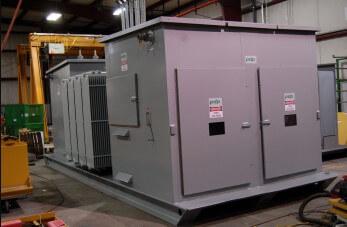
A railway power supply system is the core electrical infrastructure that delivers high-voltage electricity to traction networks, trackside signaling, and utility equipment. Swartz Engineering builds these industrial setups using heavy-duty substations, transformers, and automated switchgear designed to handle sudden load shifts from heavy freight and passenger trains.
Core Components
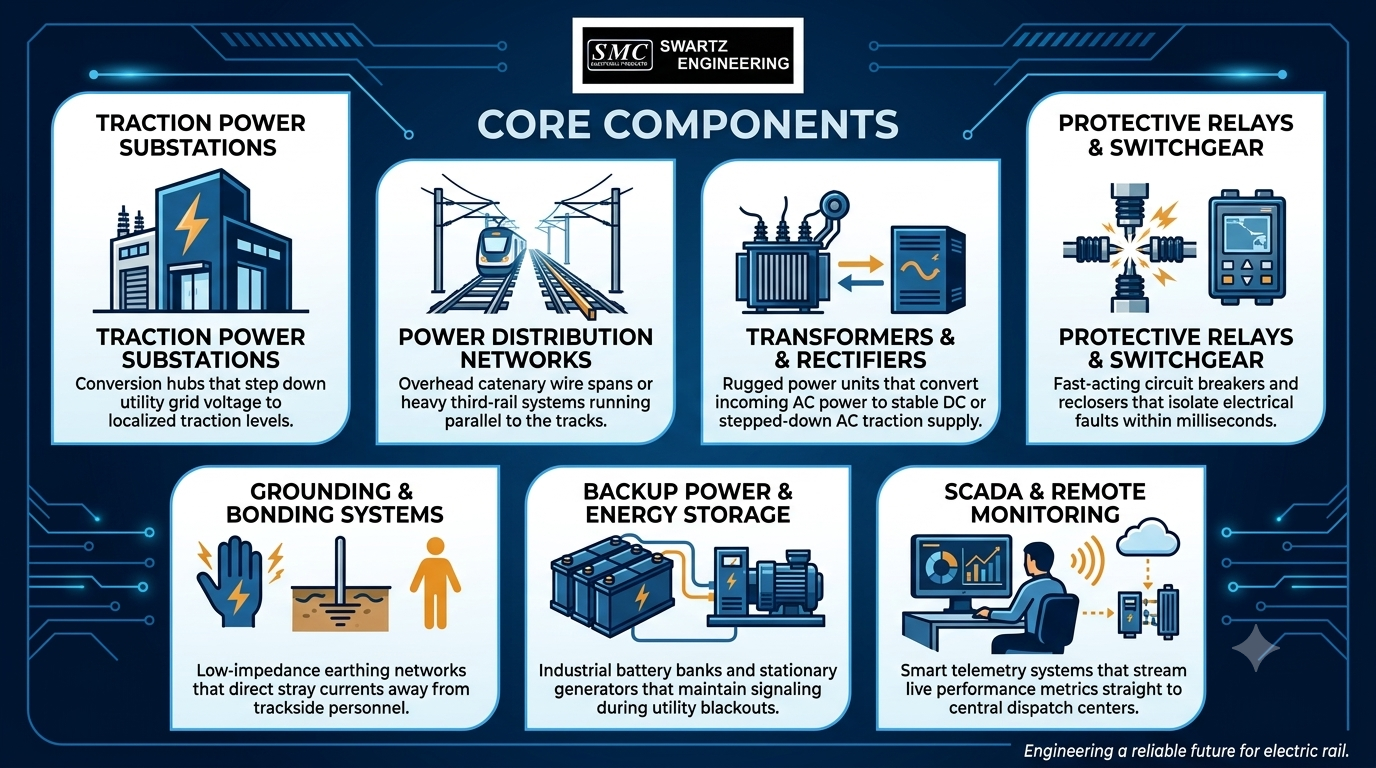
- Traction Power Substations: Conversion hubs that step down utility grid voltage to localized traction levels.
- Power Distribution Networks: Overhead catenary wire spans or heavy third-rail systems running parallel to the tracks.
- Transformers & Rectifiers: Rugged power units that convert incoming AC power to stable DC or stepped-down AC traction supply.
- Protective Relays & Switchgear: Fast-acting circuit breakers and reclosers that isolate electrical faults within milliseconds.
- Grounding & Bonding Systems: Low-impedance earthing networks that direct stray currents away from trackside personnel.
- Backup Power & Energy Storage: Industrial battery banks and stationary generators that maintain signaling during utility blackouts.
- SCADA & Remote Monitoring: Smart telemetry systems that stream live performance metrics straight to central dispatch centers.
GET IN TOUCH
The ultimate solution for reliable power control! call us at 276-285-3841
Why Is Specialized Engineering Necessary for Rail Power Infrastructure?
Rail electrical design demands precise load balancing, transient suppression, and harsh weather protection that off-the-shelf industrial hardware cannot deliver. The reality on the ground is that moving locomotives generate massive power spikes and harmonic noise back into the grid.
Specialized engineers calculate exact copper sizing, fault-current limits, and environmental clearances to prevent equipment failure. Working with expert systems designers prevents costly retrofits, keeps you compliant with strict IEEE and federal standards, and ensures stable operations across extreme thermal cycles.
How to Build a Dependable Rail Power Setup
- Analyze Electrical Loads & Utility Capacity
- Map out maximum draw requirements across peak scheduling hours, including transient spikes from accelerating locomotives.
- Evaluate utility interconnections to prevent localized phase imbalances across three-phase grid connections.
- Engineer Custom Substation Gear
- Specify outdoor-rated, lockable switchgear enclosures capable of handling high fault currents.
- Select dry-type or liquid-immersed transformers built with oil-level monitoring and advanced thermal dissipation.
- Deploy Protective Control Networks
- Install programmable reclosing relays to automatically clear temporary line faults without dispatching field technicians.
- Integrate SCADA telemetry modules using secure, fiber-optic communication lines for real-time monitoring.
- Commission, Test, & Train
- Conduct primary injection, insulation resistance, and secondary timing tests across all protective relays before energizing.
- Train maintenance crews on lock-out/tag-out procedures, arc-flash boundary protocols, and manual override switches.
Where Are Custom Railway Electrical Systems Used?
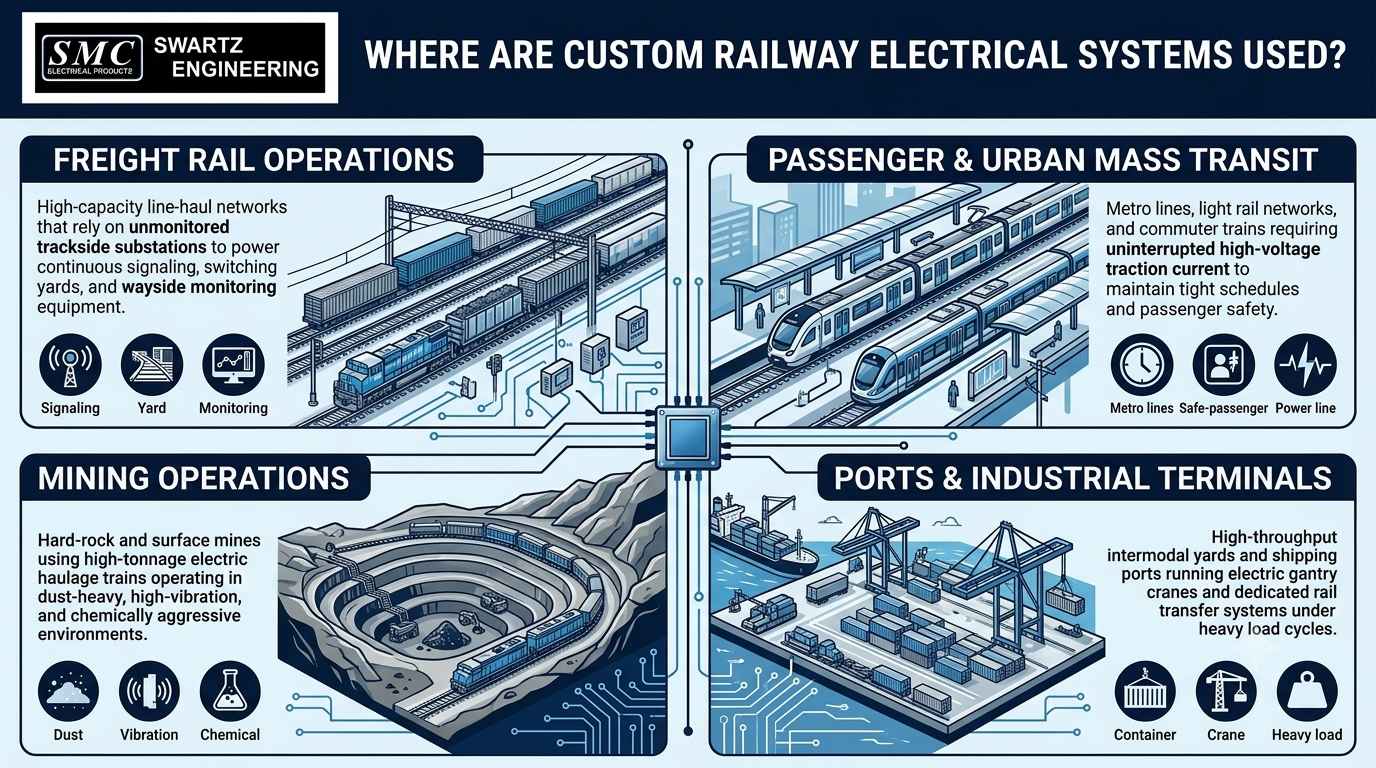
- Freight Rail Operations: High-capacity line-haul networks that rely on unmonitored trackside substations to power continuous signaling, switching yards, and wayside monitoring equipment.
- Passenger & Urban Mass Transit: Metro lines, light rail networks, and commuter trains requiring uninterrupted high-voltage traction current to maintain tight schedules and passenger safety.
- Mining Operations: Hard-rock and surface mines using high-tonnage electric haulage trains operating in dust-heavy, high-vibration, and chemically aggressive environments.
- Ports & Industrial Terminals: High-throughput intermodal yards and shipping ports running electric gantry cranes and dedicated rail transfer systems under heavy load cycles.
GET IN TOUCH
The ultimate solution for reliable power control! call us at 276-285-3841
Traditional vs. Modern Rail Power Systems
|
|
|
|
|
|
|
|
|
|
|
|
|
|
|
|
|
|
|
|
Critical Power Equipment Terminology
- Traction Power Substation (TPSS): An electrical installation that converts electrical power from a public utility grid into the specific voltage, current, and frequency required for rail vehicles.
- Autotransformer Feed System (2x25 kV): High-efficiency power distribution setup that minimizes voltage drop over long distances while feeding heavy electric trains.
- Static Frequency Converter (SFC): Power electronics equipment used to convert three-phase commercial utility power into single-phase railway traction power.
- Reclosing Relay: An automated safety controller that detects electrical faults, opens the breaker, and tests the line to restore power automatically after transient interruptions.
- Stray Current Mitigation: Specialized grounding design techniques engineered to prevent stray electrical currents from corroding underground metal utilities and track beds.
Field Notes from the Rail Yard
Here is the part most contractors will not tell you: off-the-shelf industrial transformers usually fail early when exposed to the cycling loads of heavy rail systems. Rail vehicles draw massive amperage during acceleration, creating thermal spikes that break down standard transformer insulation.
Always specify custom-wound transformer units fitted with heavy-duty cooling radiators, sudden-pressure relays, and vibration-dampening mounts to double the operational lifespan of your substations.
How to Modernize Your Railway Electrical System
Moving an older railway power system toward high-efficiency performance requires a clear, step-by-step upgrade strategy.
- Request a System-Wide Audit: Schedule an on-site thermal, harmonic, and protective-coordination evaluation of your existing substations.
- Review Custom Equipment Drawings: Work directly with electrical engineers to design modular switchgear and transformer skid assemblies tailored to your physical footprint.
- Execute Turnkey Installation: Upgrade your line section by section during planned maintenance windows to maintain active train dispatch schedules.
Ready to Upgrade Your Rail Power Infrastructure?
Upgrading your electrical distribution setup is the fastest way to eliminate operational downtime, safeguard trackside crews, and lower long-term maintenance overhead. Swartz Engineering brings decades of field-proven expertise, delivering custom-designed substations, switchgear, and traction power components built for the toughest US rail applications.
Our team works with your engineering staff from preliminary load design to final onsite commissioning. Don't let aging gear bottleneck your train operations. Call Swartz Engineering or request a direct project consultation today to secure a long-lasting, high-performance railway power supply system for your rail network.
Frequently Asked Questions
Q: What does a railway power supply system do?
A: A railway power supply system converts incoming power from public utility grids into the specific voltages required to operate trains, track signals, and trackside equipment. It uses custom substations, switchgear, and transformers to distribute electricity along track corridors.
Q: Why are custom traction power substations necessary for rail projects?
A: Custom substations handle the heavy load changes and transient power surges caused by accelerating locomotives. Standard utility gear cannot handle these extreme operational shifts without constantly tripping or suffering early insulation failure.
Q: Which industrial sectors rely on custom rail electrical systems?
A: Freight corridors, passenger transit authorities, underground mining operations, and port facilities all rely on custom electrical systems. These specialized systems deliver uninterrupted power under heavy operational loads and in harsh ambient environments.
Q: How do automated reclosing relays prevent rail service delays?
A: Reclosing relays automatically clear temporary electrical faults—like lightning strikes or tree branch contacts—by momentarily tripping and restoring circuit connection. This resets the circuit without requiring maintenance crews to drive out to remote substations.
Q: How does modern power design reduce long-term maintenance costs?
A: Engineered systems use real-time monitoring, high-efficiency transformers, and weather-resistant enclosures. These features prevent unexpected equipment burnouts, lower line losses, and let technicians fix minor issues before they cause total system outages.
Our Expert Services
Swartz Engineering provides top-quality products to achieve our customers' needs. We also make sure our products work reliably and safely. Our products include:
- Type 76 DC Relay
- Type 82 DC Relay
- Swartz Engineering’s Type 64 Ground Relay
- Type 32 Reverse Current Relay
- Type 150 DC
- CSM Shield Monitor
- Metal Oxide Surge Arrestors
- Transducers
- MVIS SL Slim-line Contactor
- Fully-tested Power Control Rooms
- Swartz Engineering’s Portable Substations
Contact Us
If you have a need for regular mobile power solutions, backups, or temporary power solutions, Swartz Engineering can deliver the crucial systems in a custom build for your needs. Contact us today to learn more about our mobile substation designs.