Modern rail systems depend on reliable electrical infrastructure to keep passengers and freight moving safely. One of the most important components is DC switchgear, which protects substations, traction power systems, and other critical equipment from electrical faults. The reality on the ground is that choosing the right solution is not simply about selecting equipment—it requires matching the switchgear to your rail system's electrical demands, operating environment, and long-term expansion plans. Working with an experienced manufacturer like Swartz Engineering, which serves rail and transportation projects across the United States, helps ensure dependable performance, improved safety, and lower lifecycle costs.
Key Takeaways
- Rapid Fault Isolation: Protective heavy-duty circuit breakers identify and isolate catastrophic thermal overloads instantly.
- Tailored Electrical Matching: Engineering custom lineups based on exact line voltages and baseline current capacity eliminates premature system failure.
- Environmental Armoring: Ruggedized enclosures combat the relentless humidity, ambient salt fog, and heavy brake-dust fouling typical of transit tunnels.
- Domestic Engineering Support: Partnering with a dedicated domestic fabricator like Swartz Engineering ensures direct line access to specialized technical support.
- True Capital Valuation: Calculating Total Cost of Ownership (TCO) past the initial procurement invoice uncovers hidden operational savings over a 30-year operational life.
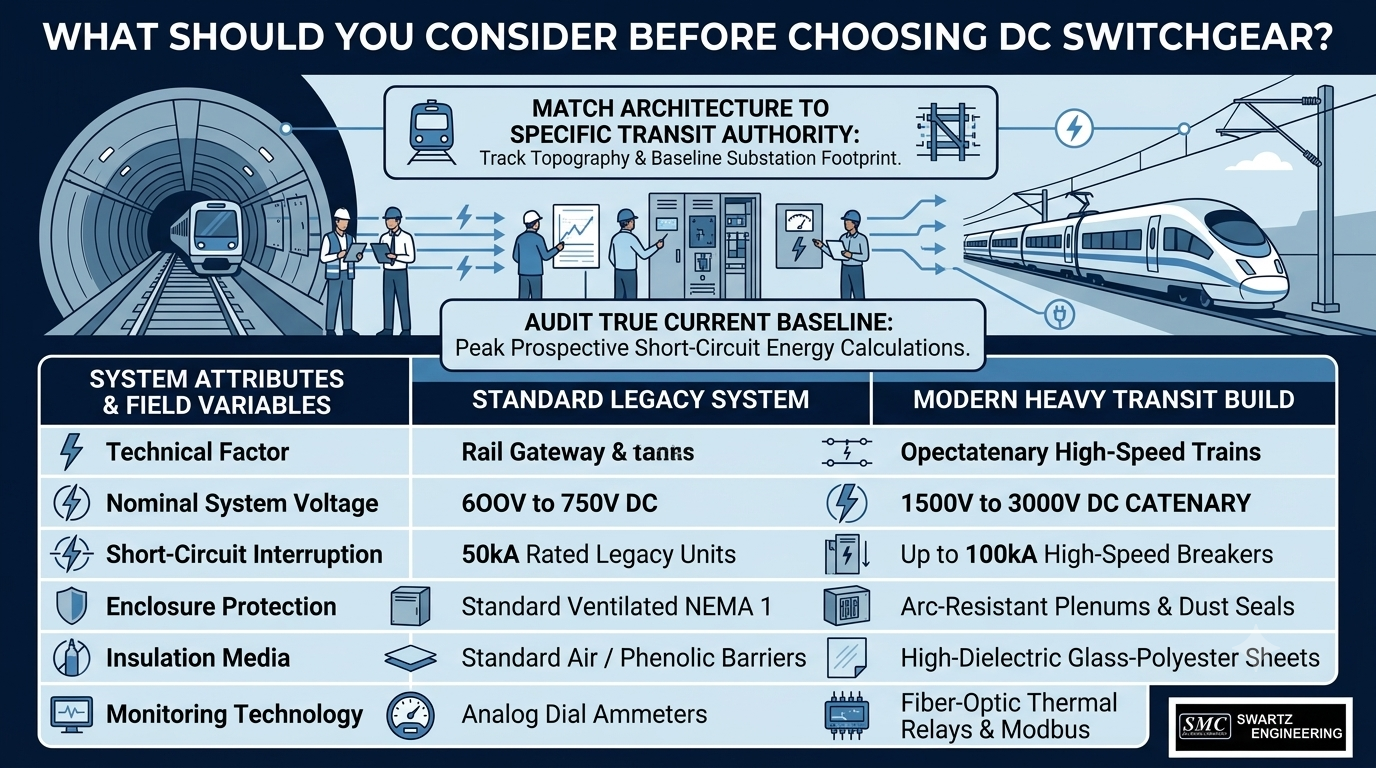
What Should You Consider Before Choosing DC Switchgear?
Selecting the correct DC switchgear architecture depends heavily on your transit authority’s specific track topography and baseline substation footprint. Dropping a generic, off-the-shelf industrial breaker cabinet into a high-capacity municipal rail grid is a recipe for catastrophic failure. Engineers must audit the system's true continuous current baseline along with peak prospective short-circuit energy calculations.
Municipal subways, overhead catenary commuter rail lines, heavy diesel-electric freight yards, and light-rail people movers utilize vastly different traction power dynamics. Matching the internal breaker specifications to these heavy-duty cycles ensures the system operates without nuisance tripping.
System Attributes & Field Variables
|
|
|
|
|
|
|
|
|
|
|
|
|
|
|
|
|
|
|
|
|
|
|
|
Local Operational Requirements
- Nominal Track Voltage: Dictates the physical clearance distances required inside the cabinet steel chassis to prevent cross-phase flashover.
- Continuous Peak Amperage: Establishes the required thickness of the main silver-plated solid copper busbars to prevent internal overheating.
- Available Short-Circuit Current: Defines the structural bracing strength needed to survive the violent mechanical twisting forces generated during a maximum fault.
- Future Transit Growth: Allocates physical space within the current lineup frame for adding future feeder breakers as train frequencies multiply.
GET IN TOUCH
The ultimate solution for reliable power control! call us at 276-285-3841
How Do Safety and Reliability Affect Your Decision?
The safety profile of transit infrastructure depends entirely on the mechanical reliability of its protective relaying. Electrical insulation breakdowns are an inevitability over decades of service, but deploying high-speed protective devices mitigates those events instantly.
Modern line-protection suites rely on rate-of-rise sensing relays to differentiate between a normal accelerating train and a dead short-circuit miles away down the track. This precise discrimination allows the main line contactors to stay closed during heavy morning passenger surges while remaining ready to isolate legitimate ground faults within a fraction of a second.
Homeowner-Focused Transit Safety Checklist
- High-Speed Isolation Breakers: Look for mechanical latching systems capable of separating main internal copper contacts within 5 to 8 milliseconds.
- De-ionizing Arc Chutes: Ensure breaker assemblies feature heavy ceramic or glass-melamine chutes designed to handle repeated maximum-capacity interruptions.
- Integrated Lockout Systems: Require robust mechanical key interlocks (like Kirk Key systems) to prevent workers from opening breaker doors while the main bus is fully energized.
- Remote Racking Mechanisms: Utilize motorized breaker racking systems so technicians can insert or remove heavy breaker trucks from outside the flash-boundary zone.
Real-World Field Insight
Field Engineering Insight: The environment inside an underground subway traction power substation is brutal. Iron brake-shoe dust combines with ambient moisture to coat insulation surfaces with a highly conductive film. When choosing switchgear, ignore laboratory ratings and focus on real-world creepage distances. Specifying localized space heaters inside the cable compartments and choosing high-track-resistance insulation barriers prevents tracking faults before they can ever bridge across your main internal bus structures.
Why Choose Swartz Engineering?
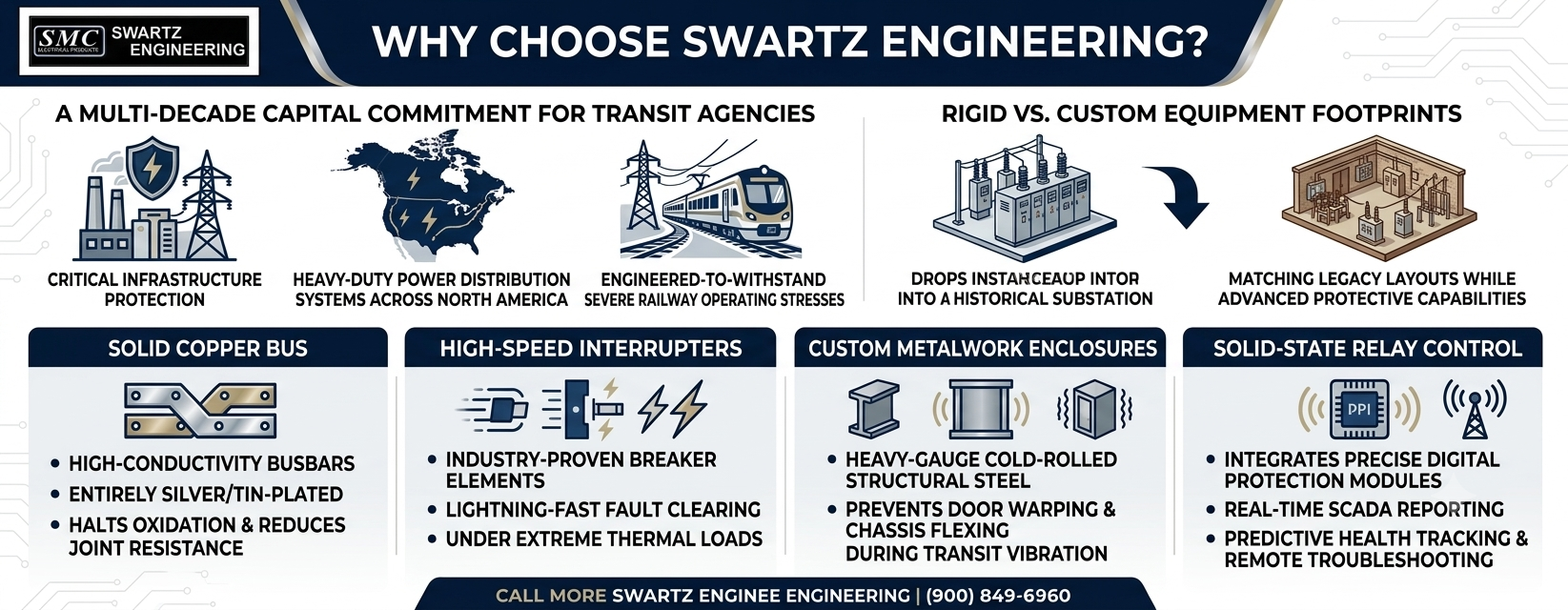
Selecting critical infrastructure protection is a multi-decade capital commitment for any transit agency. Swartz Engineering designs and builds heavy-duty power distribution systems across North America, engineering every component to withstand severe railway operating stresses.
Our engineering focus means we do not force projects into rigid, mass-produced equipment footprints. Instead, our technical teams build switchgear setups to drop cleanly into existing historical substations, matching legacy layouts while introducing advanced protective capabilities.
Multi-Layered Technical Assets
- Solid Copper Bus: High-conductivity busbars are entirely silver-plated or tin-plated to halt oxidation and reduce joint resistance over time.
- High-Speed Interrupters: Incorporates industry-proven breaker elements that deliver lightning-fast fault clearing under extreme thermal loads.
- Custom Metalwork Enclosures: Formed using heavy-gauge cold-rolled structural steel to prevent door warping or chassis flexing during transit vibration.
- Solid-State Relay Control: Integrates precise digital protection modules for real-time SCADA reporting, predictive health tracking, and remote troubleshooting.
GET IN TOUCH
The ultimate solution for reliable power control! call us at 276-285-3841
Putting Your Power Strategy into Motion
Selecting your infrastructure's protective components dictates the safety and long-term uptime of your entire rail layout. The proper configuration protects multimillion-dollar transformer rectifiers, slashes emergency downtime, keeps maintenance technicians safe, and helps avoid expensive emergency retrofits down the road. Evaluating your actual track currents, environmental dust constraints, and multi-year expansion roadmaps ensures your capital investment yields returns for decades.
For transit authorities, civil engineering firms, and municipal rail lines across the United States, Swartz Engineering fabricates the dependable, heavy-duty electrical components required to keep heavy iron moving safely. Connect with our applications engineering team today to walk through your upcoming project prints, review custom footprint drawings, and request a comprehensive equipment quote tailored to your exact transit environment.
Frequently Asked Questions
Q: What exactly is the purpose of DC switchgear on a modern rail line?
A: It acts as a heavy-duty central safety hub that monitors incoming direct current, routes power to specific track zones, and uses heavy high-speed breakers to isolate localized short circuits instantly. This action stops localized electrical failures from knocking out entire transit grids.
Q: Why can't standard industrial AC circuit breakers be used on a railway's traction power line?
A: Direct current does not naturally drop to a zero-voltage point like alternating current does, making an electrical arc incredibly difficult to stop once it forms. Rail systems require specialized DC circuit breakers with magnetic blowout coils and large arc chutes to forcibly extinguish continuous plasma arcs.
Q: How do harsh environmental elements like brake dust affect underground substation equipment?
A: Conductive metallic dust from train brakes settles on internal insulation panels over time. If moisture or high tunnel humidity is present, this dust layer creates an electrical path across the insulation, causing catastrophic phase-to-ground flashovers unless the enclosures are properly sealed and heated.
Q: What are the main electrical factors required to accurately size a new switchgear lineup?
A: Engineering teams must calculate the maximum continuous current draw of fully loaded trains, the nominal line voltage (typically 750V to 1500V DC), the available peak short-circuit fault current, and the physical space available inside the existing substation building.
Q: How does working with a domestic custom engineering firm improve a transit project's lifecycle?
A: It eliminates the long supply-chain delays common with overseas manufacturers and allows for direct collaboration on custom frame designs. This focus ensures your switchgear fits perfectly into tight historical rail vaults without requiring expensive structural building modifications.
Our Expert Services
Swartz Engineering provides top-quality products to achieve our customers' needs. We also make sure our products work reliably and safely. Our products include:
- Type 76 DC Relay
- Type 82 DC Relay
- Swartz Engineering’s Type 64 Ground Relay
- Type 32 Reverse Current Relay
- Type 150 DC
- CSM Shield Monitor
- Metal Oxide Surge Arrestors
- Transducers
- MVIS SL Slim-line Contactor
- Fully-tested Power Control Rooms
- Swartz Engineering’s Portable Substations
Contact Us
If you have a need for regular mobile power solutions, backups, or temporary power solutions, Swartz Engineering can deliver the crucial systems in a custom build for your needs. Contact us today to learn more about our mobile substation designs.