
A railway electrical system has to do more than deliver power. It must distribute electricity reliably, detect abnormal conditions quickly, isolate faults in the right location, and protect both equipment and people without unnecessarily shutting down healthy parts of the network.
That balance can be difficult in rail applications. Traction loads change rapidly as trains accelerate and brake. Equipment may operate outdoors or beside active tracks. Signaling, communications, traction power, substations, third rails, overhead contact systems, and control equipment can all interact with the electrical environment.
At Swartz Engineering, we work in electrical power distribution and build equipment for demanding applications, including rail and transportation infrastructure. The safest approach is rarely to look at one relay, breaker, or enclosure by itself. Electrical safety depends on how the complete system responds when operating conditions change or a fault occurs.
Key Takeaways
- A railway electrical system needs coordinated protection that can distinguish damaging faults from normal high-current events such as train acceleration.
- Protective relays, circuit breakers, monitoring equipment, grounding, surge protection, and control systems perform different safety functions and need to work together.
- Ground-fault monitoring can identify developing insulation problems before they cause a wider failure, but the appropriate method depends on whether the circuit is grounded or ungrounded.
- Induced voltage, electromagnetic interference, environmental exposure, and maintenance access can affect railway electrical safety beyond basic overcurrent protection.
- Railway electrical standards are application-specific, so voltage limits and protection requirements should be verified for the particular circuit, location, equipment, and operating condition.
- Factory-tested power control rooms and coordinated protection equipment can simplify installation while giving operators a centralized place to monitor and control critical electrical systems.
What Is a Railway Electrical System?
A railway electrical system is the network of equipment that supplies, distributes, controls, monitors, and protects electrical power used by rail infrastructure.
Depending on the railway, that system may include utility connections, traction power substations, transformers, rectifiers, AC or DC switchgear, feeder circuits, overhead contact systems, third rails, protective relays, circuit breakers, monitoring devices, signaling power, communications equipment, and control systems.
The exact arrangement varies considerably between heavy rail, passenger rail, urban transit, freight infrastructure, maintenance facilities, and other railway applications.
For electrified railways, power typically passes through several stages before it reaches a train. Utility electricity may be transformed or converted at a traction power substation, distributed through feeders, and delivered through an overhead contact system or third rail. Protection and control equipment supervises that path so abnormal conditions can be identified and isolated.
That last function is critical. Delivering electricity is only half the job. The railway electrical system must also control what happens when electricity goes somewhere it should not.
Why Electrical Protection Is Different in Railway Applications
Railway electrical protection must respond to faults without confusing demanding normal operation with an emergency.
A train accelerating from a station, for example, can create a substantial change in current. A protection system that reacts too aggressively could interrupt normal service. A system that reacts too slowly could leave conductors, switchgear, feeders, or other equipment exposed to a damaging fault.
This creates an important design challenge: protection has to match the electrical behavior of the railway.
Rail systems can also combine several types of electrical infrastructure. Traction power may coexist with signaling circuits, communications equipment, station loads, battery systems, control power, and utility infrastructure. Each has different operating requirements.
Effective protection therefore starts with understanding the complete network rather than selecting protective devices independently.
Core Electrical Safety Solutions for Railway Systems
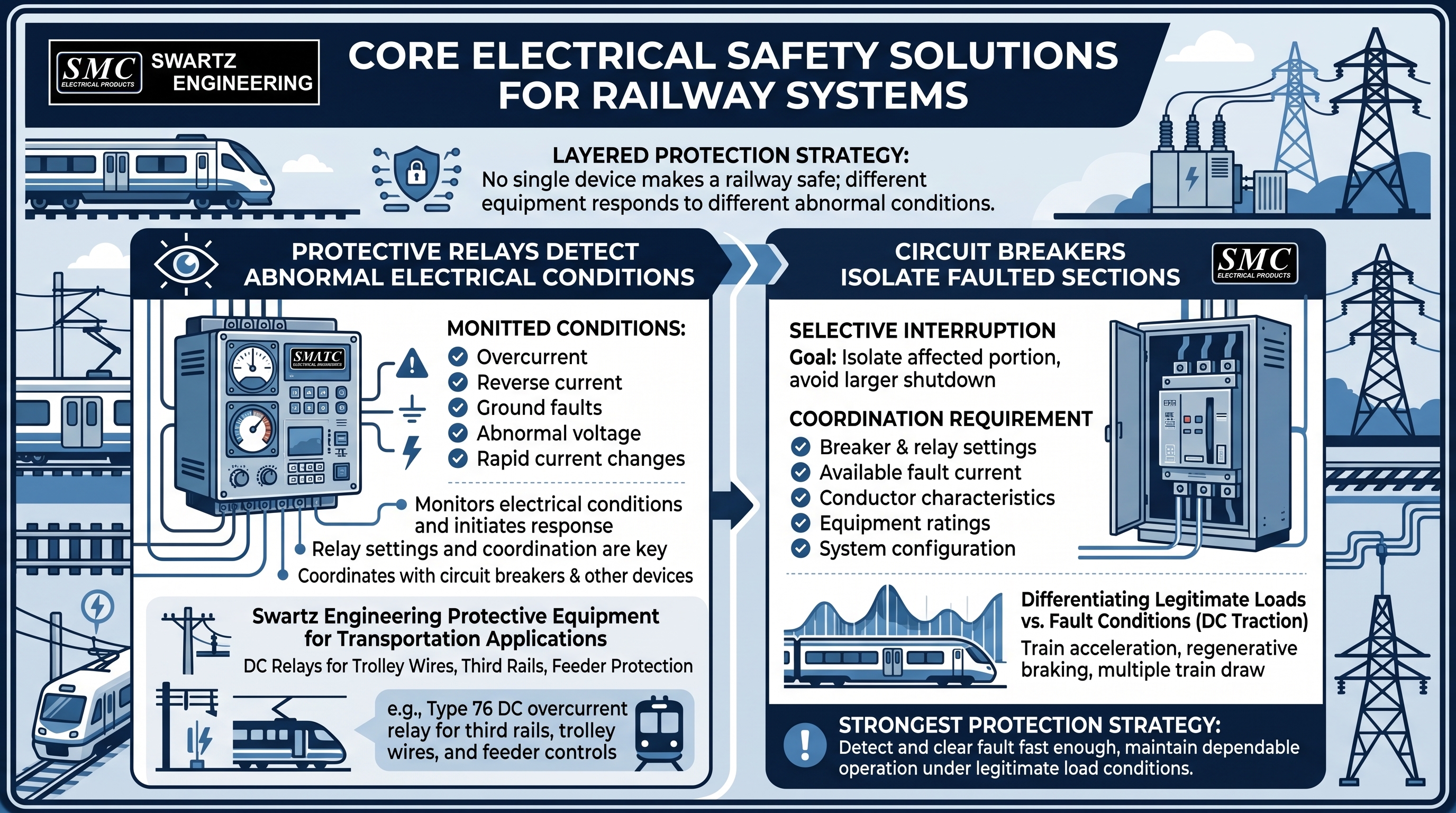
No single device makes a railway electrical system safe. Protection is usually layered so different equipment responds to different abnormal conditions.
Protective Relays Detect Abnormal Electrical Conditions
Protective relays monitor electrical conditions and initiate a response when predetermined limits or operating characteristics are reached.
Depending on the application, a railway protection scheme may monitor conditions such as overcurrent, reverse current, ground faults, abnormal voltage, or rapid changes in current.
The relay itself does not solve every problem. Its settings and coordination with circuit breakers and other protective devices determine how the system responds.
For rail applications, that coordination matters because legitimate operating current can change significantly as rolling stock accelerates, regenerative braking occurs, loads move through the network, or multiple trains draw power at the same time.
Swartz Engineering supplies protective equipment for transportation applications, including DC relays used for trolley wires, third rails, feeder protection, and related traction-power applications. Our Type 76 DC overcurrent relay, for example, is designed for transportation applications involving third rails, trolley wires, and feeder controls.
Circuit Breakers Isolate Faulted Sections
Circuit breakers interrupt current when the protection system determines that a circuit should be disconnected.
In a railway network, selective interruption is important. The goal is generally to isolate the affected portion while avoiding a larger shutdown than necessary.
That requires coordination between the breaker, relay settings, available fault current, conductor characteristics, equipment ratings, and system configuration.
For DC traction systems, this coordination can be particularly important because the system must differentiate between expected traction loads and actual fault conditions.
The strongest protection strategy is therefore not simply “trip as fast as possible.” It is to detect and clear a dangerous fault fast enough while maintaining dependable railway operation under legitimate load conditions.
GET IN TOUCH
The ultimate solution for reliable power control! call us at 276-285-3841
How Ground-Fault Monitoring Improves Railway Electrical Safety
Ground-fault monitoring can provide early warning when current begins flowing through an unintended path.
In stations, depots, substations, and other rail facilities, deterioration in cable insulation, contamination, moisture, damaged equipment, or aging components can contribute to leakage or ground-fault conditions.
Continuous monitoring can help maintenance personnel identify a developing problem before it becomes a more disruptive failure.
The correct approach depends on the system configuration.
Grounded and ungrounded systems behave differently when an insulation fault occurs. For that reason, ground-fault detection, residual-current monitoring, insulation monitoring, and ground-fault location equipment are not interchangeable solutions for every railway circuit.
The competitor material reviewed for this article emphasizes this point in station and depot environments: residual-current monitoring can detect faults before ordinary fault-current protection operates, while insulation monitoring and fault-location equipment can be used for ungrounded supplies.
For a rail operator, the practical benefit is better visibility. Instead of waiting until an electrical condition causes a major trip, maintenance teams may have an opportunity to locate deterioration earlier and schedule corrective work more deliberately.
Protection Relays and Signaling Equipment Serve Different Roles
Traction protection and railway signaling are closely related to safe rail operation, but they should not be treated as the same electrical function.
Traction protection equipment primarily protects the power system and connected equipment from abnormal electrical conditions. Signaling systems help control train movements and communicate operating authority or track conditions.
Rail suppliers may therefore provide separate classes of protection relays, signaling relays, circuit breakers, sensors, and train-protection equipment. Wabtec, for example, separates high-voltage/high-current protection relays from signaling relays, circuit breakers, train-protection systems, and electrical measurement equipment in its rail electrical portfolio.
From a system-design perspective, the important point is coordination. A fault or switching event in the power network should not create unintended effects elsewhere in critical railway infrastructure.
That means engineers may need to consider electrical protection alongside signaling compatibility, control power, communications, grounding, and electromagnetic interference.
Induced Voltage Requires Project-Specific Evaluation
Railways often run near electrical transmission infrastructure, creating the possibility of induced AC voltage on rails or associated equipment.
The correct safety limit cannot be reduced to one universal number. It depends on what is being evaluated, including whether the concern is personnel exposure, equipment protection, rail-to-ground voltage, rail-to-rail voltage, steady-state induction, or a fault condition.
AREMA's current Communications & Signals Manual includes dedicated material for circuit protection and inductive interference, showing that these conditions are treated as specific engineering subjects rather than one generic voltage rule.
Supplemental material related to AREMA practices discusses a 25 V rail-to-ground personnel-safety value for a particular steady-state induced-voltage analysis. The same material references a 50 V open-circuit source as part of a protective-device release test. Those values should not be combined into a general statement that 25–50 V is universally safe for railway workers.
The practical lesson is simple: induced-voltage limits should be evaluated against the applicable railway standard, circuit, exposure condition, and project design.
Power Control Rooms Centralize Railway Electrical Protection
A power control room gives operators a centralized environment for electrical protection, monitoring, control, and communication equipment.
Depending on the project, a railway power control room may contain switchgear, protective-relay panels, controls, communications equipment, battery or DC systems, and monitoring interfaces.
Centralization can improve troubleshooting because personnel have a defined point from which to observe system conditions and coordinate switching or fault response.
It can also simplify construction when equipment is assembled and tested under controlled factory conditions before shipment.
At Swartz Engineering, our custom-engineered power control rooms are assembled using factory-controlled quality procedures. Our company has worked in electrical power distribution for nearly half a century, and our power-control equipment is designed for demanding environments. We perform factory testing in accordance with applicable IEEE and NEMA standards for the equipment involved.
For railway projects, enclosure design matters as much as the electrical equipment inside. Moisture, corrosion, temperature changes, dust, and difficult service access can all influence long-term reliability.
Environmental Protection Is Part of Electrical Safety
Rail electrical equipment may spend decades in environments that are much harsher than an ordinary indoor electrical room.
Substations and trackside installations can be exposed to changing temperatures, moisture, contaminants, vibration, and corrosive conditions. Equipment beside an operating railway may also be more difficult to access for inspection or repair.
Those conditions can affect insulation, terminals, enclosures, conductors, and electronic equipment over time.
That is why environmental protection should be considered during equipment selection rather than treated as a maintenance issue later.
At Swartz Engineering, our power-distribution enclosures are designed for challenging environments. We use enclosure materials and protective finishes intended to improve resistance to environmental exposure while maintaining structural integrity.
For operators, durability has a direct safety connection. Equipment that stays dry, protected, structurally secure, and accessible is easier to inspect and maintain before deterioration becomes a fault.
Maintenance Access Should Be Designed Into the System
A railway electrical system cannot remain safe through protection devices alone. People must eventually inspect, test, troubleshoot, and maintain the equipment.
That makes working space, isolation capability, equipment labeling, circuit identification, access, and maintainability part of the design conversation.
OSHA's substation requirements, where applicable to the work being performed, emphasize sufficient access and working space around electrical equipment so employees can operate and maintain it safely.
Railway projects require particular care when determining which rules apply. Some OSHA electrical-utilization provisions specifically exclude railway installations used exclusively for traction power or signaling and communications. Applicability therefore depends on the installation and work activity rather than on assuming ordinary commercial-building requirements automatically govern every railway circuit.
Good engineering accounts for maintenance from the beginning. A protective device that is difficult to test, isolate, inspect, or replace can create operational problems later even if its electrical rating is correct.
What Should Engineers Evaluate When Selecting Railway Electrical Protection?
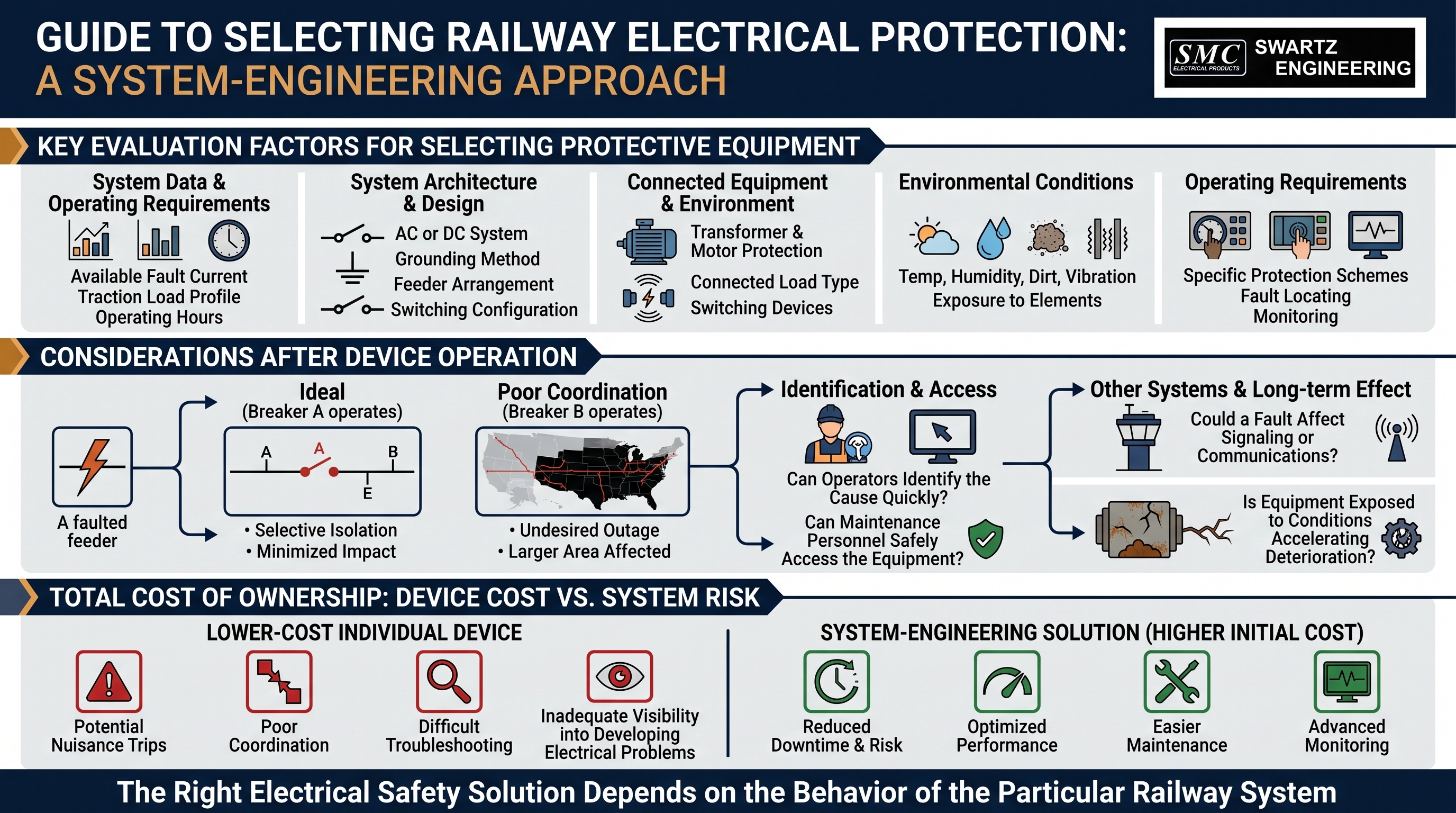
The right electrical safety solution depends on the behavior of the particular railway system.
Before selecting or setting protective equipment, engineers typically need to understand the available fault current, traction load profile, AC or DC system architecture, grounding method, feeder arrangement, switching configuration, connected equipment, environmental conditions, and operating requirements.
They also need to consider what happens after a device operates.
Will one breaker isolate only the faulted feeder, or a much larger section of the railway? Can operators identify the cause quickly? Can maintenance personnel safely access the equipment? Could a fault affect signaling or communications? Is the equipment exposed to conditions that could accelerate deterioration?
These questions turn protection from a component-selection exercise into a system-engineering problem.
A lower-cost individual device is not necessarily the lower-risk solution if it creates nuisance trips, poor coordination, difficult troubleshooting, or inadequate visibility into developing electrical problems.
GET IN TOUCH
The ultimate solution for reliable power control! call us at 276-285-3841
Building a Safer Railway Electrical System
A safer railway electrical system comes from layers of coordinated protection.
Power distribution equipment has to carry demanding railway loads. Protective relays must identify abnormal conditions. Circuit breakers must isolate faults. Monitoring equipment should give operators useful information. Grounding and ground-fault protection need to match the system architecture. Control equipment must provide visibility. Enclosures have to protect critical components from the environment.
Those pieces work best when they are engineered as one system.
At Swartz Engineering, we support power-distribution applications with equipment that includes DC protection relays, switchgear-related solutions, transducers, surge protection, monitoring equipment, power control rooms, and other equipment used in demanding electrical infrastructure. Our focus is on providing equipment that can be integrated into the protection and control strategy required by the project.
For railway operators, engineering firms, EPC contractors, and transit authorities, the starting point should be the electrical behavior and operating requirements of the network. From there, the protection system can be designed around the faults that need to be detected, the equipment that needs to remain available, and the people who will operate and maintain it.
Talk With Swartz Engineering About Railway Electrical Protection
Railway electrical safety depends on more than choosing individual protective devices. Relay coordination, switching, monitoring, environmental protection, maintenance requirements, and the behavior of the complete traction-power network all affect the final design.
At Swartz Engineering, we design and supply electrical power-distribution equipment for demanding infrastructure applications. If you are planning a new railway electrical system, replacing aging protection equipment, or integrating protection and control into a traction-power project, contact our team to discuss the electrical requirements and equipment needed for your application.
Frequently Asked Questions
Q: What are the main parts of a railway electrical system?
A: A railway electrical system may include utility supplies, traction substations, transformers, rectifiers, switchgear, feeders, overhead contact systems or third rails, circuit breakers, protective relays, signaling power, communications systems, controls, monitoring equipment, and auxiliary power. The exact configuration depends on the railway and its electrification method.
Q: Why are protective relays important in railway electrical systems?
A: Protective relays identify abnormal electrical conditions and initiate actions such as opening a circuit breaker. In railway applications, relay settings must account for normal conditions such as high acceleration current while still detecting faults quickly enough to protect equipment and infrastructure.
Q: How does ground-fault monitoring help railway operators?
A: Ground-fault monitoring can identify leakage or deteriorating insulation before a more serious failure occurs. Early detection can make troubleshooting easier and may allow maintenance personnel to address a developing problem before it causes a wider interruption. The appropriate monitoring method depends on whether the electrical system is grounded or ungrounded.
Q: What is the difference between a protection relay and a circuit breaker?
A: A protection relay monitors electrical conditions and determines when a protective action is required. A circuit breaker physically interrupts the current. In a coordinated protection scheme, the relay detects the abnormal condition and commands the appropriate breaker to isolate the affected circuit.
Q: Are there universal safe voltage limits for railway tracks?
A: No single voltage value applies to every railway electrical condition. Acceptable limits can depend on whether the issue involves rail-to-ground voltage, rail-to-rail voltage, signaling equipment, personnel exposure, induced AC voltage, steady-state conditions, or a fault. Engineers should apply the appropriate railway and electrical standards to the specific installation.
Q: Why use a factory-built power control room for railway infrastructure?
A: A factory-built power control room can bring protection, switching, monitoring, and control equipment into a coordinated enclosure that is assembled and tested before shipment. This approach can reduce field integration work while providing a controlled environment for critical electrical equipment. The final configuration still needs to be engineered around the railway project's electrical and operating requirements.
Products We Offer
Swartz Engineering strives to provide top-quality products to achieve our customer's needs. Our products include:
- Type 76 DC Relay
- Type 82 DC Relay
- Swartz Engineering’s Type 64 Ground Relay
- Type 32 Reverse Current Relay
- Type 150 DC
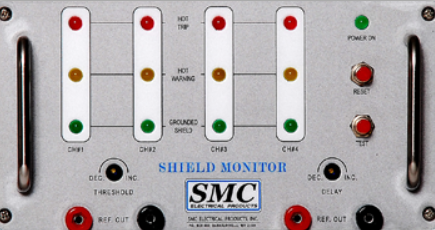
- CSM Shield Monitor
- Metal Oxide Surge Arrestors
- Transducers
- MVIS SL Slim-line Contactor
- Fully-tested Power Control Rooms
- Swartz Engineering’s Portable Substations
For nearly half a century, we have proudly led the industry in ensuring safety and efficiency. Swartz Engineering is a trusted family-owned company dedicated to providing top-notch power distribution solutions for the electrical industry. Contact us today.