Reliable rail service starts long before a train draws power from an overhead line or third rail. The electrical system has to supply the required load, maintain acceptable voltage, respond correctly to faults, coordinate with other rail systems, and remain practical to operate and maintain.
At Swartz Engineering, we support rail traction power projects from early system studies through detailed design, equipment specification, field support, testing, commissioning, and modernization. That continuity matters because traction substations, feeders, protection, grounding, controls, and current-collection systems do not operate independently. A change in one area can affect performance elsewhere in the network.
Whether you are developing a new rail corridor, expanding an existing network, or upgrading aging electrical infrastructure, the goal is the same: build a traction power system that meets the actual operating requirements of the railway rather than treating individual components as separate purchases.
Key Takeaways
- Rail traction power design should begin with operating loads, voltage requirements, fault conditions, utility supply, and future capacity—not equipment selection alone.
- AC and DC rail systems require different conversion, distribution, protection, and current-collection arrangements.
- Traction substations must be coordinated with feeders, protection systems, grounding, SCADA, overhead catenary, or third-rail infrastructure.
- Load-flow, fault, power-quality, and capacity studies can identify problems before equipment is purchased or construction begins.
- Testing and commissioning should confirm that protection, controls, communications, and power equipment work together before revenue service.
- Existing rail systems may be candidates for targeted modernization rather than complete replacement when studies show the existing infrastructure can support upgrades.
What Is Rail Traction Power?
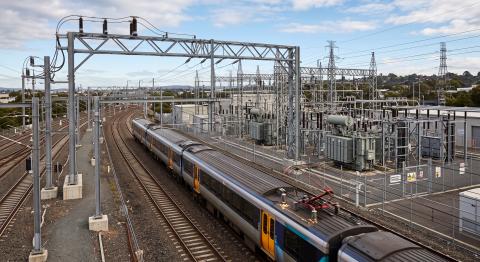
Rail traction power is the electrical infrastructure that supplies energy to electrically powered trains. The system takes utility power, transforms or converts it as required, distributes it along the railway, and delivers it to trains through an overhead contact system or third rail.
A typical system may include traction power substations, transformers, rectifiers, switchgear, circuit breakers, protection relays, feeders, return circuits, grounding and bonding, controls, monitoring equipment, and the associated current-collection infrastructure.
The exact configuration depends on the railway. DC traction is common in many metro, light-rail, and urban systems, while AC configurations are widely used for higher-voltage rail applications. The equipment and protection strategy must match the voltage, rolling stock, service pattern, utility connection, route length, and operating conditions of the project.
Traction substations form a critical part of this network because they convert utility-supplied electricity into the voltage and current required by the railway. Swartz Engineering's rail material identifies transformers, rectifiers, switching equipment, and protection as core elements depending on whether the system uses AC or DC traction power.
Start With the Traction Power Requirements, Not the Equipment
A rail traction power project should start by establishing what the railway actually needs the electrical system to do.
Selecting a transformer, rectifier, or switchgear lineup before the load conditions are understood can create problems later. Train frequency, acceleration, gradients, station spacing, rolling-stock characteristics, regenerative braking, utility capacity, feeder distances, and planned expansion can all affect the electrical design.
Early engineering studies can answer questions such as:
- Can the proposed substations support peak train service?
- Will voltage remain within acceptable limits along the route?
- Are feeders sized for present and future rolling stock?
- What fault current must protective devices safely interrupt?
- How will regenerative braking affect the network?
- Does the available utility connection have enough capacity?
- Where should substations or feeding points be located?
Swartz Engineering's documented railway power support includes load-flow analysis, short-circuit and fault calculations, harmonic and power-quality studies, regenerative-braking analysis, capacity forecasting, and utility interconnection assessments.
These studies reduce guesswork. They also give owners, EPC contractors, and transit agencies a technical basis for major equipment and infrastructure decisions before those decisions become expensive to change.
Rail Traction Power System Design for AC and DC Networks
Rail traction power design has to coordinate electrical performance with the physical railway and its operating plan.
For a DC system, the substation may step down incoming AC power and use rectifiers to produce the DC supply needed by the trains. For an AC railway, traction transformers and associated switching and protection equipment deliver the required AC supply to the electrification system.
Our detailed design work can include:
- Traction substation layouts
- AC and DC power distribution
- Protection and relay coordination
- Grounding and bonding
- Negative-return systems
- Stray-current control
- Cable schedules and routing
- Control and SCADA integration
Swartz Engineering identifies these areas as part of its construction-ready railway electrical design packages.
Good design also accounts for interfaces. A protective relay setting can affect breaker operation. Cable routing can change electrical characteristics. Grounding decisions can influence safety and stray-current performance. SCADA has to communicate with the equipment it supervises.
The system therefore needs to be engineered as a network, not as a collection of unrelated components.
Traction Power Substations and Equipment
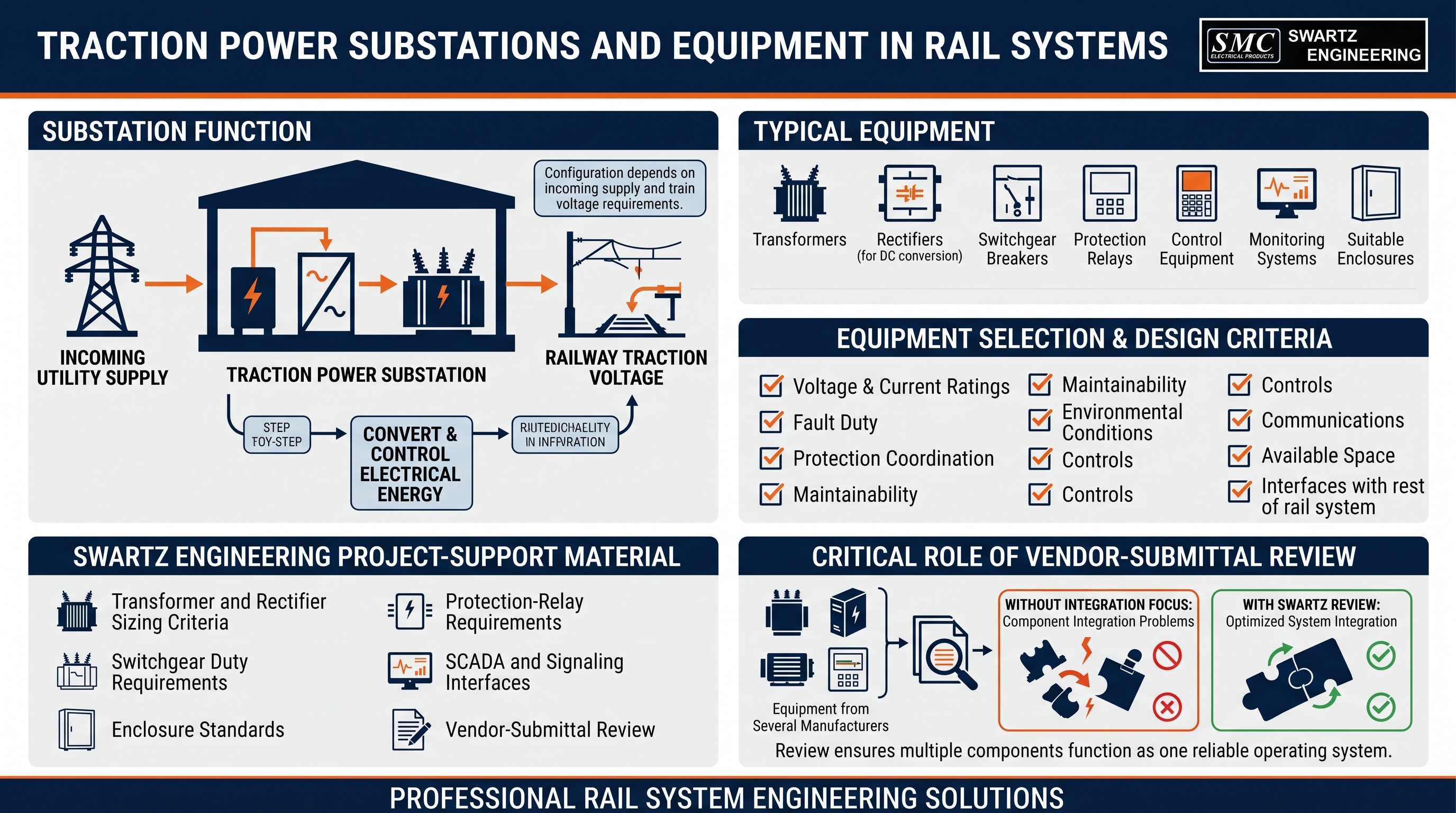
Traction power substations convert and control the electrical energy needed to operate the railway. Their configuration depends on the incoming utility supply and the traction voltage required by the trains.
Typical equipment considerations include transformers, rectifiers where DC conversion is required, switchgear, circuit breakers, protection relays, control equipment, monitoring systems, and suitable enclosures.
Equipment selection involves more than checking voltage and current ratings. The design team also needs to consider fault duty, protection coordination, maintainability, environmental conditions, controls, communications, available space, and interfaces with the rest of the rail system.
Swartz Engineering's current rail project-support material includes transformer and rectifier sizing criteria, switchgear duty requirements, protection-relay requirements, enclosure standards, SCADA and signaling interfaces, and vendor-submittal review.
This review becomes particularly important on projects involving equipment from several manufacturers. Individual components can meet their own specifications and still create integration problems when assembled into one operating system.
GET IN TOUCH
The ultimate solution for reliable power control! call us at 276-285-3841
Overhead Catenary and Third-Rail Power Delivery
Once electrical power leaves the traction substation, it still has to reach the train.
Electric rail systems generally use an overhead contact arrangement or an energized third rail for current collection. The appropriate solution depends on the type of railway, operating voltage, route configuration, clearance, rolling stock, maintenance requirements, and existing infrastructure.
The traction power design must account for the relationship between substations, feeders, the current-collection network, and the electrical return path. Those relationships influence voltage drop, power availability, protective-device operation, and system performance.
This becomes especially important on extensions and modernization projects. Connecting new electrical infrastructure to an operating rail system may require more analysis than designing an isolated new installation because the new equipment must work within the limitations and protection philosophy of the existing network.
Why Grounding, Bonding, and Stray Current Need Early Attention
Grounding and bonding are safety and system-performance issues, not details to leave until construction.
Rail traction systems can create unusual return-current conditions. In DC networks especially, uncontrolled stray current may leave its intended return path and travel through nearby conductive structures. That makes the design of return circuits, bonding, grounding, and stray-current control an important part of the wider traction power strategy.
Swartz Engineering includes grounding and bonding systems, negative returns, and stray-current control within its railway power design work. Field support can also include ground-grid continuity checks and verification of installation details.
Resolving these requirements early also helps avoid conflicts with signaling, communications, civil infrastructure, utilities, and other conductive systems along the corridor.
Protection and Control Must Match Real Fault Conditions
A traction power protection system needs to detect abnormal electrical conditions and isolate the affected part of the network without unnecessarily removing healthy sections from service.
That sounds straightforward, but protection performance depends on actual fault levels, equipment ratings, network configuration, relay settings, and coordination between devices.
A study may show, for example, that a proposed breaker does not have the required interrupting rating or that changes in feeder configuration affect the expected fault current. Protection settings must also be coordinated so that the correct device operates when a fault occurs.
This is one reason fault analysis should be completed before equipment is finalized.
Swartz Engineering's rail support includes short-circuit analysis, protection and relay coordination, relay and breaker setting validation, and commissioning tests used to confirm protection operation.
SCADA and Intelligent Monitoring Improve Visibility
Modern traction power systems increasingly use digital monitoring to give operators a clearer picture of electrical conditions throughout the network.
Depending on the system, monitoring may include feeder loading, breaker status, fault events, alarms, substation conditions, and other operating data. Remote visibility can help maintenance teams locate faults faster and identify equipment or capacity trends before they become operating problems.
Swartz Engineering supports areas including substation monitoring architecture, feeder-load analytics, fault-event recording, remote condition monitoring, and modernization of existing systems.
Monitoring is most useful when it is incorporated into the project architecture rather than added after equipment and communications interfaces have already been defined.
Testing and Commissioning Before Revenue Service
Testing and commissioning confirm that the installed rail traction power system performs as intended before it is relied on for normal operation.
Individual equipment tests are necessary, but they are only part of the process. The project also needs to verify interfaces among protection devices, controls, SCADA, breakers, substations, feeders, grounding systems, and other connected infrastructure.
Commissioning support may include factory acceptance testing, site acceptance testing, relay testing, protection-coordination confirmation, functional SCADA checks, and controlled energization procedures. Swartz Engineering lists these activities within its current railway power project support.
A structured commissioning process can uncover wiring errors, incorrect settings, communication problems, equipment defects, or interface issues before they affect railway operations.
For a new line, that helps create a more controlled path toward startup. For an existing system, careful sequencing becomes even more important because testing or energization may have to occur around active service.
New Rail Project or Existing-System Upgrade?
Not every traction power project starts with a blank sheet of paper.
New rail systems give engineers more freedom to coordinate substation locations, feeders, current collection, controls, and future expansion from the beginning.
Existing systems pose a different question: what can be retained, and what actually needs to change?
Before replacing existing equipment, an engineering review may examine:
- Present and future electrical load
- Existing transformer or rectifier capacity
- Breaker interrupting ratings
- Protection limitations
- Equipment condition and supportability
- Grounding and return-current performance
- SCADA and monitoring capability
- Space for additional equipment
- Compatibility with new rolling stock
- Planned service or headway increases
In some cases, an existing substation can be upgraded with new protection, controls, or higher-capacity equipment instead of being completely replaced. Swartz Engineering supports system audits, capacity reassessments, protection upgrades, retrofit design, expansion studies, and modernization programs.
The correct choice depends on the condition of the existing assets and the performance the railway will require after the project is complete.
What Can Make a Rail Traction Power Project More Complex?
The electrical one-line diagram does not reveal every project risk.
Several practical conditions can change the design or delivery strategy.
Expanding Service Without Adding Enough Power Capacity
Shorter headways or different rolling stock may increase peak electrical demand. An existing system that supports today's timetable may not have enough margin for tomorrow's service plan.
That is why capacity studies should use realistic operating scenarios instead of relying only on existing measured load.
Integrating New Equipment With Legacy Infrastructure
Older substations may use equipment, relay philosophies, controls, or communication protocols that differ substantially from modern replacements.
A retrofit has to address those interfaces rather than assuming new equipment can simply replace old equipment one-for-one.
Working Within an Active Rail Corridor
Construction and testing around operating railway infrastructure can restrict access, outage windows, cable routing, and energization sequences.
Design documents need enough detail to support field decisions without encouraging improvised changes near energized or safety-critical systems.
Planning for Future Expansion
A design that meets today's service requirement but leaves no practical path for additional capacity may create expensive reconstruction later.
Future rolling stock, extensions, train frequency, and utility constraints should therefore be considered during initial modeling when those plans are reasonably known.
How Do You Choose a Rail Traction Power Partner?
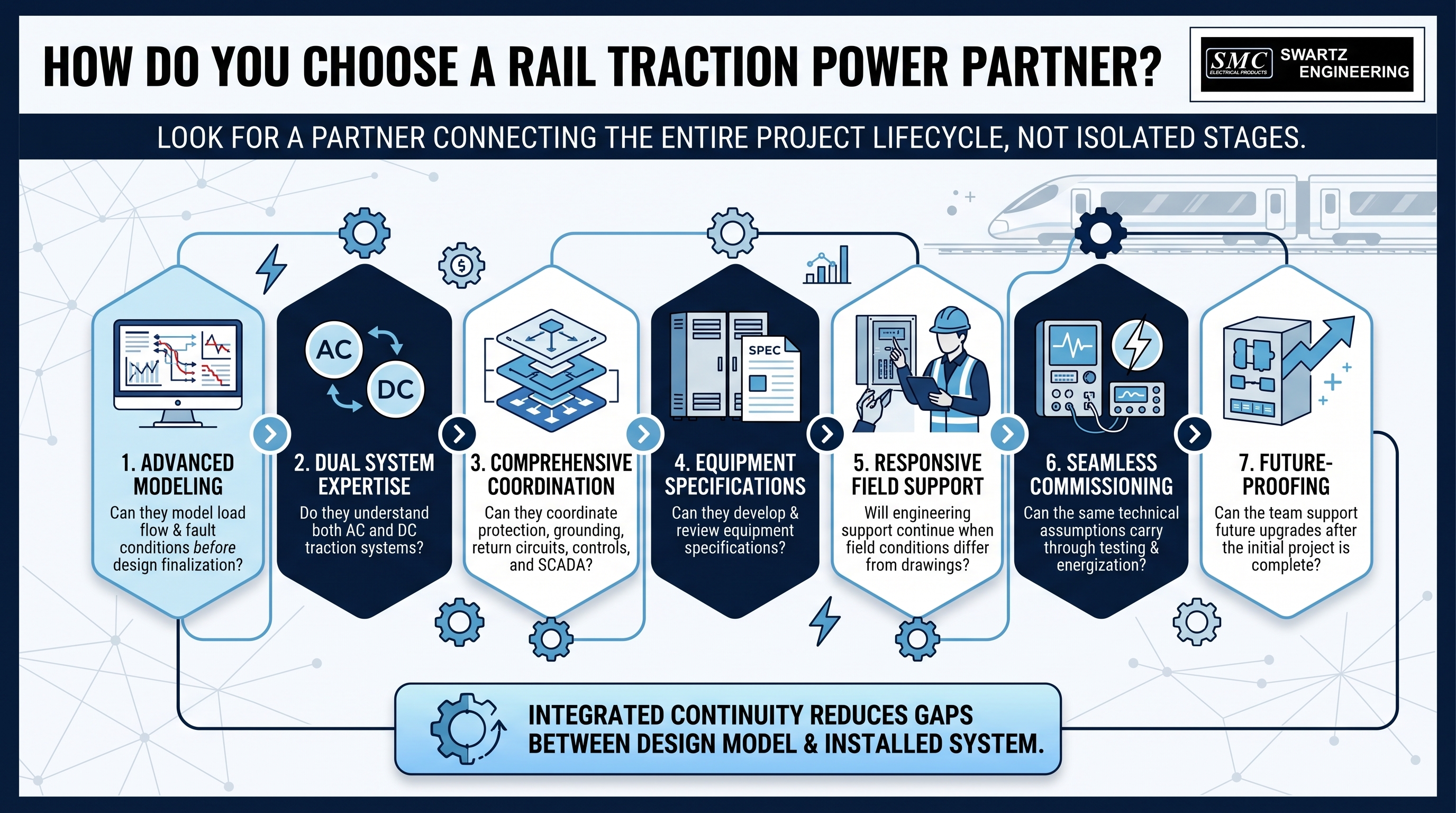
Look for a partner that can connect system analysis, electrical design, equipment requirements, field conditions, and commissioning rather than treating each stage as an isolated assignment.
For a substantial rail traction power project, useful questions include:
- Can the team model load flow and fault conditions before design decisions are finalized?
- Does it understand both AC and DC traction systems?
- Can it coordinate protection, grounding, return circuits, controls, and SCADA?
- Can it develop and review equipment specifications?
- Will engineering support continue when field conditions differ from the drawings?
- Can the same technical assumptions be carried through testing and energization?
- Can the team support future upgrades after the initial project is complete?
That continuity can reduce gaps between the design model and the system that is eventually installed.
GET IN TOUCH
The ultimate solution for reliable power control! call us at 276-285-3841
Why Work With Swartz Engineering?
At Swartz Engineering, power distribution is our core field. We are a family-owned company with nearly half a century of industry history, designing and supplying electrical power-distribution solutions for demanding applications. Our equipment is designed for challenging environments, and our company describes factory testing performed in accordance with applicable IEEE and NEMA standards for its custom-engineered power control room products.
For railway and transit applications, our support can extend across the project lifecycle—from electrical studies and traction substation design to equipment specification, field engineering, testing, commissioning, monitoring, retrofits, and expansion planning.
That gives project teams a common engineering thread as the system moves from calculations and drawings to installed equipment and operating infrastructure.
Get Rail Traction Power Support for Your Project
A dependable rail traction power system starts with understanding how the entire network needs to perform.
If you are planning a new railway, adding capacity, replacing aging traction substations, upgrading protection and controls, or preparing an existing network for future service demands, we can help evaluate the electrical requirements and develop a solution around your project.
Contact Swartz Engineering to discuss your rail traction power requirements and the engineering, equipment, testing, or modernization support your project needs.
Frequently Asked Questions
Q: What does a rail traction power system include?
A: A rail traction power system typically includes substations, transformers, rectifiers where DC conversion is required, switchgear, protection equipment, feeders, controls, return circuits, grounding and bonding, and an overhead or third-rail current-collection system. The exact configuration depends on the railway's operating voltage and design.
Q: What is the purpose of a traction power substation?
A: A traction power substation converts electricity from the utility supply into the voltage and current required by the railway and distributes that power to the traction network. Depending on the rail system, this may involve voltage transformation alone or transformation followed by AC-to-DC rectification.
Q: What is the difference between AC and DC rail traction power?
A: AC rail systems supply trains with alternating current, while DC systems supply direct current and generally require rectifiers within the traction power conversion process. The appropriate arrangement depends on the rail network, operating voltage, rolling stock, route, and existing infrastructure.
Q: Why is load-flow analysis important for a railway?
A: Load-flow analysis helps engineers determine how voltage and power behave throughout the traction network under expected operating conditions. It can identify voltage-drop or capacity concerns and help evaluate whether substations and feeders can support planned train service.
Q: Can an existing traction power substation be upgraded?
A: Yes, depending on its condition and electrical capacity. An engineering assessment may determine that protection, controls, monitoring, or selected power equipment can be upgraded instead of replacing the entire substation. Capacity and fault studies should be completed before deciding on the scope.
Q: When should traction power engineering begin on a rail project?
A: Traction power engineering should begin early enough to influence utility requirements, substation locations, capacity, equipment ratings, current collection, grounding, protection, and major interfaces. Resolving these issues before procurement and construction gives the project more options and can reduce expensive field changes.
Products We Offer
Swartz Engineering strives to provide top-quality products to achieve our customer's needs. Our products include:
- Type 76 DC Relay
- Type 82 DC Relay
- Swartz Engineering’s Type 64 Ground Relay
- Type 32 Reverse Current Relay
- Type 150 DC
- CSM Shield Monitor
- Metal Oxide Surge Arrestors
- Transducers
- MVIS SL Slim-line Contactor
- Fully-tested Power Control Rooms
- Swartz Engineering’s Portable Substations
For nearly half a century, we have proudly led the industry in ensuring safety and efficiency. Swartz Engineering is a trusted family-owned company dedicated to providing top-notch power distribution solutions for the electrical industry. Contact us today.